
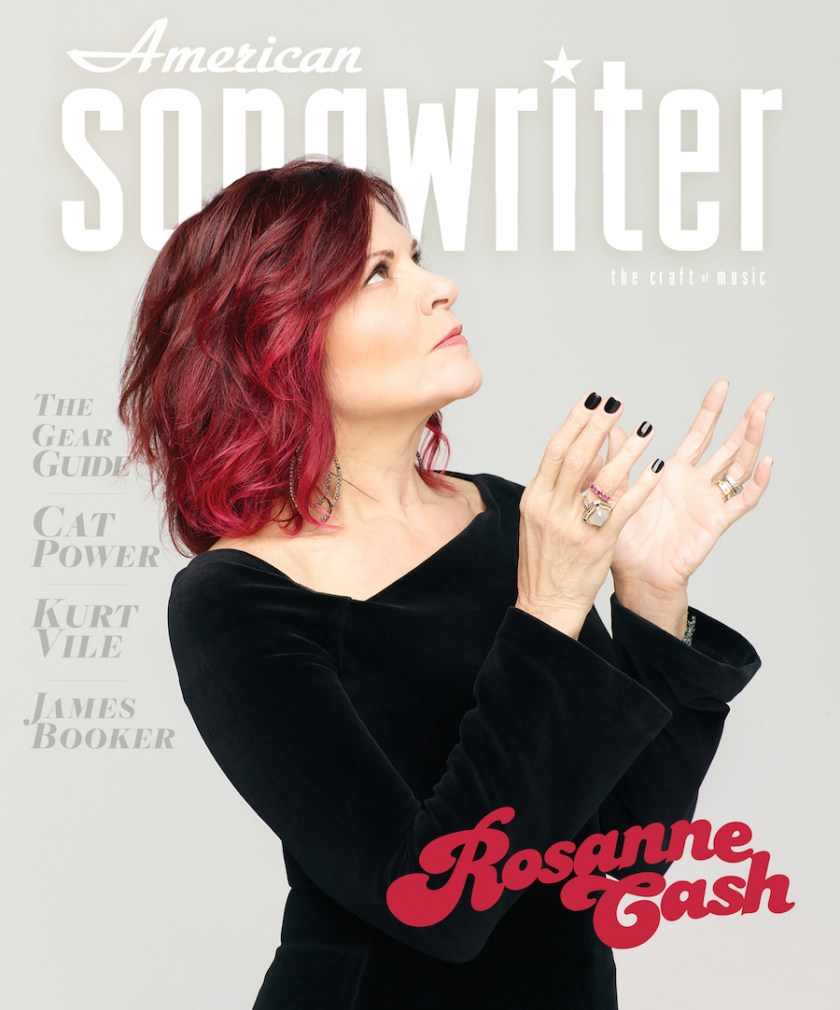
Cover story for March/April 2019 edition of American Songwriter.
Let It Be
Gary Clark Jr. was ready to take a stand.
When the Texas artist entered Arlyn Studios in downtown Austin to begin making This Land at the beginning of 2018, he wanted to get some things off his chest. Since the release of his last album in 2015, The Story of Sonny Boy Slim, Clark had, like the rest of us, been a witness to the greatest political and sociological shockwave to hit the United States since the Long Hot Summer of 1967. The Black Lives Matter movement, which first took root in 2014, had reached a crescendo after a raft of highly publicized killings of black Americans at the hands of police. From that followed the protests of NFL quarterback Colin Kaepernick and other players, who, as a show of solidarity with the movement, opted to kneel during the playing of the National Anthem. And then there were the events in Charlottesville, the picturesque college town that ended up playing host to a white supremacist rally that resulted in the vehicular homicide of one protester and the injury of 40 others. There had been more, and set parenthetically within the election of Donald Trump, it was clear something had changed in the ether of the republic.
There had been changes in Clark’s personal life too, mostly for the better. In 2016 Clark married his Australian model girlfriend Nicole Trunfio and the two are now parents to Zion, who is four, and one-year-old Gia. The couple also bought a 50-acre ranch just outside Clark’s hometown of Austin. Life was good, but the artist felt a growing angst within.
The swirling currents of the past three years had cut into Clark’s personal experience and created a need for an outlet of expression. According to producer and engineer Jacob Sciba, who’d also worked on the Sonny Boy record, it was this sense of urgency that informed much of the recording process. Clark was also determined to elevate the level of his songwriting, and this time around he wanted to have a message, to use his voice for the greater good. In short, he wanted to say something. “No more ‘Mr. Nice Guy,’” he told Sciba, “he’s dead.”
*****
I first meet up with Clark backstage before a show in Chattanooga, in late 2018. The album’s first single and title track, “This Land,” has not been released. When the video for the song drops in January, it makes a considerable splash. Directed by British-born filmmaker Savanah Leaf, the video is conceived as short film that features several black children in the Texas countryside, situated among Confederate flags and other emblems of the Old South. Clark’s character is holed up in a white-columned mansion throughout, “right in the middle of Trump country,” shredding on a Gibson SG next to a raised American flag.
Sciba knew it couldn’t be radio-edited and because of the raw power of the song he felt a twinge of concern for his friend of 10 years, knowing Clark was opening himself up to attack. Indeed, the video sparked a backlash from a portion of Clark’s audience via social media, who accused him of playing the “race card” and cashing in on the hot-button issues of the day.
Clark responded days later on Twitter in very clear terms: “People want to escape through music to be entertained and take their mind off of reality. I’m not an entertainer. I want to be in the middle of it and face reality in my life and be honest about my feelings.” What he did not say on Twitter, but did reveal to Rolling Stone after the video’s release, was that the song’s lyrics stemmed from an incident he’d had with a neighbor at the ranch. According to Clark, the neighbor had approached him and said, “Who owns this house?”, refusing to believe it could belong to someone who looked like Clark. All of which happened in the presence of Clark’s young son, who was left shaken and confused by the incident. Clark kept his cool in the moment, but tough questions followed. What had been swirling in the ether was now on the ground. A short while later Clark’s venom found its way into “This Land” when he wrote:
I remember when you used to tell me
‘Nigga run, nigga run
Go back where you come from
Nigga run, nigga run
Go back where you come from
We don’t want, we don’t want your kind
We think you’s a dumb bum’
Fuck you, I’m America son
This is where I come from
This land is mine.
My first question for Clark on the night we meet is about the song. Clark, who stands a wiry 6 feet 5 inches, is soft-spoken and demure, and there is a real gentleness about him. He takes some time before answering.
“I just got on the microphone and just let it out, you know?,” he says. “It’s hard to explain these songs. I spent my whole life being black in Texas and [there’s] blatant and subtle and abrasive discrimination. With the current climate politically, it’s like, ‘What the fuck is happening?’ Everyone just wants to be treated like a human being. We all have family and people that we love and care about, and we’re trying to take care of them and support them like everybody else and we’re here. We’re here. We’ve all migrated from somewhere in this land and we’re here … You can spend your whole life being pissed off at somebody that you don’t understand, but at the end of the day, you’re going to be buried right next to them. So what are you going to do?”
Sciba knew the song was a game-changer as soon as Clark shared the words. “I heard the song as a beat for seven months, and then one day all of the sudden I heard a lyric, and Gary was like, ‘I think I have something.’”
“It’s scary in a sense because Gary is such a calm and peaceful guy,” Sciba explains, speaking by phone one night after a studio session at Arlyn. “He’s very sweet and soulful and this is very aggressive … but I knew it was something that was going to get people’s attention. So let it be. If it offends, it offends.”
“This Land” subtly samples Sharon Jones and the Dap Kings’ R&B version of “This Land Is Your Land,” recorded by the group in 2005. Woody Guthrie wrote the original lyrics in New York City in 1940, inspired by a recent cross-country road trip he’d taken. He also wrote it as a response to Irving Berlin’s jingoistic “God Bless America,” which was dominating the airwaves at the time. The original lines include the more socialist-leaning verse that questions the notion of private property, a section largely omitted from schoolbooks.
For much of her professional life, Woody Guthrie’s daughter Nora has worked on behalf of her father’s legacy, as the former director of the Woody Guthrie Archives in New York City and through projects like the Billy Bragg and Wilco Mermaid Avenue albums. She says it’s been fascinating to watch how “This Land Is Your Land” has figured into American battles for social, economic and political justice through the decades.
“Sometimes the song is like a hymn or prayer. Sometimes it’s like an anthem. And sometimes it’s like a battle cry,” she says. “But no matter what the tone, taking a line from Woody’s ‘The Ballad of Tom Joad,’ the song belongs to ‘wherever people are fighting for their rights, that’s where I’m gonna be.’ So this is how, and where, Gary Clark Jr. is taking the fight now, with genuine passion and grit.”
Like so many Americans, Clark learned “This Land Is Your Land” as a kid at school.
“It’s one of the first songs we learn and we sing it together – it’s like the Pledge of Allegiance,” he says. “And when you’re kids, everybody’s together. You don’t see differences until you get older, and older people influence you to think about other people a certain way. I just want to get back to singing that song like we were kids again, you know? It’s fucked up when people don’t want to. There’s a huge debate over the NFL and people taking a knee. It’s lost what it’s supposed to be because people got so offended and hurt by it personally that they don’t want to understand what the message is. It’s like, ‘We want to be seen. We want to be respected.’ It’s been too long, it’s been too long. Our heroes and the people that we look up to, they either get murdered or exiled for trying to speak up and do the right thing for our people.”
Early Days
Gary Clark Jr. was born in the Oak Hill section of Austin, Texas in February of 1984. He was the second of four children and the only boy. His dad, Gary Clark Sr., sold cars for a living and his mother, Sandy, worked as an accountant. They were Baptists. It was a decidedly middle class existence.
Clark’s parents weren’t professional musicians but they embraced music: his mother’s Curtis Mayfield and Jackson 5 records were on the turntable, while Clark’s dad preferred B.B. King and the funkier stylings of Johnny “Guitar” Watson. He likely inherited the performance bug from his mom, who taught him to moonwalk as a child. When Clark was three, his parents surprised the family and took the kids to see Michael Jackson perform in Denver. Seeing Tito Jackson on stage with the guitar was a eureka moment for the young Clark. He never forgot it.
Seven or so years later, while in the fourth grade, Clark wrote his first song. It was called “Dream Girl” and he wrote it with his friend Ryan. It was about a girl named Courtney whom they both had a crush on. Clark had written the words down on yellow legal paper, which he carried in his pocket for what seemed like an eternity. When he and Ryan finally summoned the courage to sing it for her, she was unimpressed. Back to the drawing board, he thought to himself.
When he was in middle school in the mid-’90s, a classmate named Eve Monsees, whom he’d known since the third grade, got a guitar. She earned instant cool points at school and Gary wanted in on the action. That Christmas he asked his parents for a guitar, specifically requesting a “Mute Guitar,” a term he got from the setting on his dad’s Casio keyboard that made the notes sound funky. He got an Ibanez RX-20 electric. He’d been listening to his parents’ records at the time and the first song he attempted to play was “I Want You Back” by The Jackson 5, later trying his hand at other soul hits. (“Kind of one-note type of stuff,” he says.) He hit the school library when Christmas break ended and checked out a few books on guitar instruction, getting a handle on the basic chords. Then he started buying Guitar World magazine at the grocery store and began to hear the licks in songs, noticing little things from the instrument he hadn’t before. “I just ran with it,” he says.
To this day, Clark has never taken a formal lesson. In those early days Monsees was always a step ahead. At the time she was in an all-girl band that played mostly Ramones songs. She and Gary competed against each other in the 7th-grade talent show and then joined forces the next year, performing Stevie Ray Vaughan’s “Pride And Joy” and taking top prize. Clark has credited Monsees, who today performs regularly in Austin with her band Eve and the Exiles, as being his early mentor. He even gave her a shout-out when he accepted his Grammy in 2014 for “Best Traditional R&B Performance” for the song “Please Come Home.”
“I feel like he gives me more credit than he should sometimes,” says Monsees, whose day gig involves running Antone’s Record Shop in Austin. “He was someone who had a great ear and a natural ability to pick up on things.”
Sometime in 1998 Eve and Gary found their way to Babe’s, a now-defunct sports bar on Sixth Street that hosted a weekly blues jam on Sunday nights. For a middle-schooler, Eve was preternaturally hip to the music scene, Clark says, and the outing was her idea. That night on stage she performed “Pride And Joy,” along with “T-Bone Shuffle” by Texas blues great T-Bone Walker.
Before long, the duo began hanging regularly at the smoke-filled club and jamming with everyone from high-schoolers to grizzled pickers in their 70s. When they hopped on stage for a song or two a guitarist might call out, “Hey, we’re going to play Freddie King’s ‘Hide Away.’ Do you know it? Don’t worry, we’re just going to cue A. Just watch me,” Clark relates. So they’d just comp the A, soaking it all in.
Some of the musicians burned them CDs. Stuff from Lightnin’ Hopkins, Albert Collins, Magic Sam, old B.B. King recordings. “It just went on and on,” Clark says. “Every time we’d show up, we would learn about someone new … They would give us the chance to be up there and have that experience on stage while teaching us.”
It wasn’t long before Gary and Eve caught the ear of Clifford Antone, the late owner of Austin’s storied blues club Antone’s. He invited Eve and Gary to perform at one of the club’s blues jams. Soon they’d be playing regular gigs in various dives along Sixth Street, even on school nights, with X’s on their hands to denote “underage” status.
By this time, Clark was living and breathing the blues. “It took over everything,” he says. “I mean, I don’t really have any memories. Everything kind of faded away. It was just music. It was just the blues. It was like [Eve and I] had our own secret as young kids … it was music that wasn’t popular on the radio that all the other kids were listening to … it was like, ‘Holy cow, treasure over here.’”
Around the time school took a backseat, as did basketball, with Clark quitting the JV team so he could focus on guitar, a fellow student once told him, to his puzzlement, “Black folks don’t play the blues.” But Clark had found his musical home. He’d end up scrambling to finish his homework five minutes before class because he’d blown it off the night before. “I’d spent that time trying to figure out how to solo to Albert Collins’ ‘If Trouble Was Money.’ It was that, all day, all night.”
Clark was also writing — a lot. He had a big volume of Langston Hughes poems that he’d lug around and mine for inspiration. When he was supposed to be taking notes in class he was drawing in his notebook or writing poems and stream-of-consciousness passages. “My mom was going through that stuff a little while ago,” he says, “and she said, ‘I don’t know how you got out of school, all the stuff you wrote has nothing to do with school.’”
10,000 Songs
One night before a show several years ago, Clark was hanging with Sean McCarthy, a fellow Austinite and music biz vet who works with Jimmie Vaughan. They’d known each other for some time and McCarthy mentioned he wanted to share some tunes. Clark was expecting just a handful. Instead, McCarthy ended up giving him an entire hard drive of more than 10,000 songs, a lot of it stuff the artist hadn’t heard before.
By this time Clark had set up a home-rig with his laptop, turntables and beloved Akai MPC X drum machine, his main editing tool. It wasn’t long before he was chopping up songs from the hard drive and making beats, thinking at the time no one would hear them. “Then I thought, ‘Maybe, eventually, I’d start throwing them around and see if rappers or singers wanted to get on them,” he says. “But then I was like, ‘No, this is kind of good. I’ll keep this for me.’”
Most of the songs that appear on This Land grew out of the patterns Clark created on the MPC X. Since completing the Sonny Boy Slim album and setting up the home-rig, Clark had been constantly making music, programming beats, almost like a man possessed, Sciba says. And though it might seem surprising that a musician so renowned for his guitar prowess would find that much creative inspiration in a drum machine, to Sciba, it makes perfect sense.
“Those beats are still his musical patterns and heartbeat and I think that’s what makes him special,” Sciba says. “But he doesn’t program in a classic hip-hop style, he programs like a blues kid who uses different color palettes. He still has the musical knowledge of a melodic guitar player even when he’s programming a drum sound. It’s not a Pro Tools cut and paste. And his pocket on a drum kit is about as nasty as it gets. He could be playing pencils on a desktop, and it’s going to be funky.” (Clark began playing acoustic drums off and on as a teenager.)
Like most musicians, Clark doesn’t think in terms of genres. He sees the thread in everything. It was during his teenage years, not long after he began playing guitar, that he became aware of the monofilament that runs from the blues all the way through hip-hop.
“Let me play something for you,” he tells me in Chattanooga, his eyes lighting up. He picks up his iPhone, notices a few texts from his wife, and then dials up 2Pac’s song “Krazy” from the rapper’s posthumously released 1996 Don Killuminati album.
The guitar comes in and Clark says when he first heard the song it reminded him of riffs he’d heard in the music of Stevie Ray Vaughan. “It’s the blues,” Clark says, smiling. “It makes sense to me. He’s a rapper, but he’s a storyteller. And it’s bluesy.” When you consider that Clark was soaking up the sounds of B.B. King alongside the works of 2Pac, Dr. Dre, and hip-hop producers like DJ Premier and J Dilla, it all becomes clear.
“With black music, I feel like it kind of took a turn somehow,” Clark continues, noting that he’s been called “musically schizophrenic” in the past. “[At some point], blues was kind of abandoned and started to get funkier and more rebellious, I’d say. Right around when Johnny ‘Guitar’ Watson dropped ‘Ain’t That A Bitch’ [in ’76], we kind of went that way, and I feel like other artists took the blues and made it this big, electrified rock thing. I guess instead of going that way, I was like, ‘Well, what I’m doing is just a continuation of the blues.’ I think Big K.R.I.T. is a hip-hop artist, but I feel like he’s the Muddy Waters [of the time].”
At 32, Big K.R.I.T. is just a few years younger than Clark and, like Muddy Waters, hails from Mississippi. When I mention K.R.I.T.’s song “The Vent,” a brooding, plaintive number that laments the passing of some of K.R.I.T.’s comrades, not to mention Kurt Cobain, Clark says, “I mean, I cried listening to that. It’s heavy and you feel it. You can feel it.”
As a fledgling artist, Clark had difficulty wrestling with his elastic musical tendencies, especially given that he was being hailed as the next great blues champion. Then one day at Stubb’s in Austin he had a chat with Atlanta R&B singer Cody Chesnutt. Clark told Chesnutt he’d written a batch of songs that weren’t traditional blues, but felt sheepish about releasing them to the world lest the blues police call him out for it. Chesnutt told Clark he’d be doing the world a disservice if he kept the music to himself.
“He told me, ‘That’s your soul and that’s what you do. You’re grabbing the message and translating it somehow.’ And I was like, ‘Okay, there are no rules.’”
********
With This Land Clark was determined to make a lasting piece of art. And he was willing to obsess over every last detail that went into it. In preparation, he immersed himself in some of the great pop albums of all time, classic offerings that had moved him in the past like Michael Jackson’s Thriller and Off The Wall, Nirvana’s Nevermind, as well as works by Neil Young, OutKast and Bruno Mars. “I was just revisiting what it was about these albums that made me feel a certain way,” he says.
Clark has said he often struggles with lyrics and often they are the last piece of the pie to emerge. He says he still writes in notebooks; sometimes, it’s just a song title he’ll jot down and come back to later. Other times he’ll make voice notes on his iPhone where he’s either singing, humming a melody, or beat-boxing. In the studio he’ll often hit record and just start singing into the mic, freestyling to his heart’s content and then try to build something from that. “I try to make it all make sense in my head, so it sticks that way,” he says. “But if I can’t sing it naturally, or it just doesn’t flow, then maybe it’s not the right pattern.”
*****
This Land stands as a virtual survey of black American music, a widescreen offering that connects the tissue between blues, hip-hop, reggae, Stax- and Motown-era soul, Prince, the Jackson 5, and more. Some of the material sampled came directly from McCarthy’s hard drive, including music from Guyana reggae artist Johnny Braff, R&B/jazz sax-man King Curtis, and ’50s soul group The 5 Royales. But it must be noted, Sciba says, that Clark doesn’t sample in the conventional hip-hop sense, where it’s often obvious to the listener which song is being lifted. “[With Gary], the sample is not the same melody or riff … he’s merely sampling the sounds and the vibe of the song. And it becomes an instrument that can be replayed in any form that it wants to take.”
The album, for the most part, was built piecemeal at Arlyn. Sciba, who doesn’t believe there’s a quantum leap between a demo and a final track, knew everything Clark brought in didn’t need to be re-cut. Clark started off the recording process playing a lot of the instruments himself. By and by they enlisted supporting personnel, players like hip-hop and jazz bassist Mike Elizondo (Dr. Dre, Eminem), Austinite drummer Brannen Temple (Tedeschi Trucks Band), and, among others, percussionist Sheila E., who added some magic to the song “I Got My Eyes On You,” one of the more straight-up rock numbers and one Clark co-wrote with Sciba.
Much of This Land sports a definite Prince vibe, so it makes sense that Clark and co. reached out to Sheila E., another artist with an Austin connection. The Los Angeles-based musician who performed on Purple Rain and other projects by His Royal Badness is also the niece of Alejandro Escovedo. It was assistant engineer Joseph Holguin who suggested Sheila E., whom Clark listened to as a kid alongside records by Janet Jackson and Whitney Houston. “It was a spiritual experience being in the studio with her,” Clark says. “What she added to the record, it’s such a vibe-enhancer. I don’t think the album would be nearly as effective without her.”
Guitar Man
Don’t let the drum machine talk fool you — Gary Clark Jr. is still very much a Guitar Man. Even on the beat-heavy track “This Land,” his guitar playing glows. In Chattanooga, he made sure to deliver the signature fireworks on stage. Trading off on his Gibson SG, an Epiphone Casino, and an Ibanez, Clark stretched out and wailed on tunes like “When My Train Pulls In,” an old fan favorite that he likes to run with. “I like to use all the colors on guitar and I still enjoy it,” he says. “But I’m trying to stretch out and educate myself in music theory and trying to play piano more and understand how that works, so I can never become stagnant or stale [on guitar]. I’m going to be as fierce and as fiery as I can until my fingers won’t let me do it anymore.”
Some of the more guitar-centric offerings on the new album include “Low Down Rolling Stone,” which boasts a big, beefy almost Stones-ish riff. “The Governor” is a sing-songy acoustic blues that vaguely recalls Leadbelly, while “Dirty Dishes Blues” is low-down Texas electric blues, reminiscent of Lightnin’ Hopkins, the style’s leading practitioner.
For the recording process, Clark mostly used his new signature Gibson SG, which he’s outfitted with single-coil P-90 pick-ups for extra edge. He then funneled that sound into a Cesar Diaz 100-watt head that he ran through a Marshall cabinet, he told Guitar Player magazine. There are moments on This Land when he gets loud, really loud. “Gotta Get Into Something,” a Ramones-style romper that turned more than a few heads in Chattanooga, is the first time Clark’s gone full punk. For too long, Clark says he felt pigeonholed as a trad blues, R&B, and early rock-and-roll guy. Those days are gone.
“A lot of times you get into a business and [people say] you don’t want to confuse people, and you have to think of the audience as a demographic and blah, blah, blah,” he says. “You start thinking about art and how to make it, and all those things I never thought about, and all the sudden you’re having conversations about it. So I would have to put these things [like punk songs] to the side and say, ‘I may get to this someday.’ But you know what, I’m 34 years old, I don’t know when someday is. I love all kinds of music … and this is my life. At the end of the day, it’s how I express myself. So it’s all or nothing at this point. I’m going to give you all of it. It’s what I love. I don’t care what anybody says. And so far, it’s been cool.”
*****
Gary Clark Jr. has high hopes for This Land, an album he’s carefully nursed for the better part of a year and a half. He’d like for it to travel as far and wide as possible, reaching new ears that haven’t heard his music before. He knows there are more important things in the world, and that art is a first-world concern. Still, he feels his statement is important, and he wants it to be respected and appreciated for what it is.
“I can’t let myself get too wrapped up in it,” he says. “But yeah, I want all of it. All of the awards and everything.”
But for Gary Clark Jr., one gets the sense that, in his heart of hearts, art is its own reward.





 Caine O'Rear