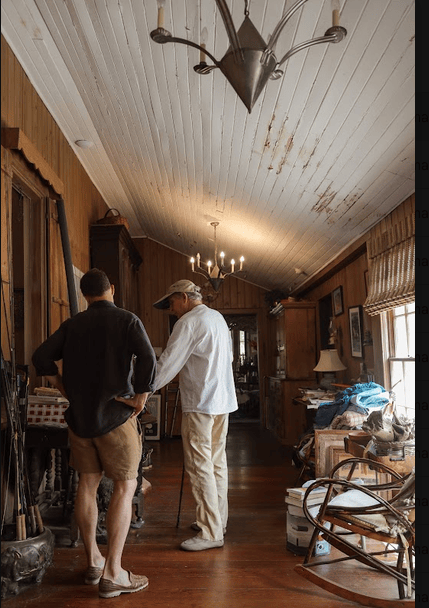
The mullet are jumping this summer morning in August. It has not rained in days and the water looks relatively clear, almost green in the early sunlight. I am sitting on a bench under a live oak overlooking Mobile Bay with Jimbo Meador, in front of his house in Point Clear, not far from the hotel. We are drinking coffee and the way these mullet are jumping it’s clear they’ve been drinking it too.
This is the house where Jimbo has lived most of his adult life with his wife, Lynn, and where he raised his two children, Bo and Carolyn. Prior to that it was the house of his wife’s parents. Built in the 1850s, it typifies other coastal cottages of that time period along the Bay with its long galleries and low-form broad roofs which were designed to enhance ventilation in the long, hot summers. It reminds me of another antebellum house along the boardwalk, where I lived one July without air-conditioning at the age of eight, a time punctuated by the sound of a rickety ceiling fan and a black-and-white television tuned constantly to the videos of MTV.
From the bench to the right stands Jimbo’s wharf, where he has cast his fly rod and bait net over the decades and stood sentinel over one of his greatest loves: the Bay. He has seen it change greatly over time. He remembers the days when the water was always clear and seagrass covered its bottoms and gigging flounder with a spear was a daily pastime.
I don’t think there’s anyone who personifies Mobile Bay more than Jimbo. Like those people who seem to blend into the land from which they come and take on its colors and topographical features, Jimbo almost seems to be a natural extension of the water, as much so as a blue heron that melts into the marshes and muddy bottoms of the Delta.
Save for a stint working for Beretta gun company, every job Jimbo’s held has been water-related: shrimping, tug-boat captain, a designer of fishing kayaks, seafood distributor, eco-tour guide in the Delta, the list goes on.
For some time this certified Master Naturalist has been a sort of spiritual godfather to Mobile Baykeeper, having in recent years developed a keen friendship with our director William Strickland. Jimbo knows the watershed as well as anyone and his memories and knowledge of the Bay and Delta are crucial to draw from as we work to build a better future for our waters.
An icon in the world of fly fishing, Jimbo defies any clichés associated with the “sportsman” or “outdoors-type.” He is a true Southern eccentric: a storyteller and natural-born humorist with a deep interest in Eastern spiritual practices. He has counted among his friends such luminaries as Jimmy Buffett, Guy de la Valdène, Tom McGuane, and Jim Harrison.
Winston Groom dedicated the book Forrest Gump to Jimbo, and it seems Groom’s hero shares more than a few characteristics with our interview subject. Jimbo’s voice was somewhat famously the model for Tom Hanks in the film version of the book. And the fact that we’re sitting here, chatting on a bench under an oak tree hung with Spanish moss is, well, a little uncanny.
As the morning unwinds our talk drifts over a continent of subjects, almost all having to do with the water. What shines through in hearing Jimbo’s tales is his deep sense of spirituality, and the life-affirming quality of his time spent in harmony with our natural world. Our talk only scratches the surface, but there is plenty more where this came from. This fall will see the publication of his long-awaited book, Short Stories From a Life Well-Lived: Stories by & about Jimbo Meador. It can be pre-ordered at JimboMeador.com, and is sure to be a must-read for any lover of the water.
Until then, we’ll let Jimbo talk.
Early lessons
I was into nature probably more than anybody my age. I had a trapline and I wanted to be a mountain man. I sold furs. I took a correspondence course in taxidermy when I was about ten. I found a mail-order catalogue and I ordered everything I could find about trapping and the outdoors. I was just always fascinated with it. I’ve been blessed with all of that. In fact, the Bible tells us to take care of this—that God created this for us and we should take care of it.
Master naturalist
I took tours up in the Delta for a good while. One time I pulled up in a little bayou, and the lotuses were blooming. I had some women in the boat. We pulled in there and one woman stood up and she said, “There is a God.” I’d take those tours and show people all the vegetation and talk to them about it. I’d show them the invasive species and say, “You know what the worst invasive species is?” And they’d say, “What?” I’d say, “Us.”
The vegetation up there in the Delta is really important. It holds the land, you know. It also supplies a lot of life. People don’t realize how much life there is under the water that they don’t see. I once had some nets made, and I’d take kids up there and let them scoop down in the water and show them all this stuff. I had these little plastic goldfish bowls and we would see all the life that was in there in just one scoop.
And those little bowls I had, I’d let them keep them and watch the stuff and then release it. It said “Catch and Release” on the thing. I’ve forgotten where I got those things. But yeah, kids loved it. And their parents did, too. Parents enjoy seeing their kids enjoy it. But yeah, it’s a pretty unique place.
But this whole Bay—I mean, see how it’s brown? We once had seagrasses all in here. And the seagrass is a habitat for all marine life—crabs and shrimp and all kinds of fish. So we’ve destroyed a whole habitat with muddy water. For example, if I tell people, “If you put a tarpaulin over your grass, without photosynthesis, how’s it going to live?” Well, the Bay’s the same way. Muddy water is a tarpaulin, and as long as the water’s muddy we can’t have vegetation. So it’s like putting a tarpaulin over your garden, you know. You’re not gonna produce much.
Read the rest from CURRENTS (Fall 2026) here. Photo by Courtney Mason.


