If you ask any first-class gourmand where to find the best oysters in the world, they will tell you to look in the claires of France or along the western coast of Ireland. Certainly in the shallow waters around Prince Edward Island in the Gulf of St. Lawrence, or in Wellfleet Harbor, Cape Cod. Somewhere in the Gulf of Mexico? Not a chance.
If they are really savvy, they will tell you about Mali Ston Bay, an oyster utopia on Croatia’s Dalmatian Coast where a variety of European flat oyster can be found that is so precious Roman emperors once funded commercial farms there, and still, two millennia later, Austrian emperor Franz Joseph was insisting that his monthly shipments to Vienna come from Mali Ston alone. In Franz Josef’s day, five hundred miles by train would be about the same as shipping overnight on a 747. In logistical terms, halfway around the world.
Such is the love for this strange and wonderful bivalve and the lengths we will go to get them — nowhere is too far to send for the best. So whether you take them by the dozen on the half-shell or fried on a po-boy, with a bottle of France’s sparkliest or with an icy schooner of what made Milwaukee famous, the humble and posh oyster inspires a love that runs deep into the heart of many cultures and culinary traditions.
The Gulf, however, has not enjoyed the same reputation for quality as these other fabled appellations. Even before the concerns brought by the BP oil spill, there was the long-held conception that the Gulf waters are too warm and turbid, and that the coastal beds where our oysters develop their unique flavor profile are not briny enough.
So what we always lacked in quality, we made up for in quantity. At least we did until BP, an event that wiped out somewhere between 4 to 8 billion oysters — a loss that has taken the mollusk three generations to replenish.
As recently as 2019, the U.S. Department of Commerce designated Alabama as one of several Gulf states whose seafood had been greatly endangered.
Hard numbers and the effects of the spill aside, such conceptions about the Gulf’s fitness for growing world-class oysters are not the whole truth. The key to growing a world-class oyster is not in a body as large as the Gulf or even as small as a single bay. And as bad as the spill was, is, the waters are healing. In beds that may be only as large as a few acres, the perfect conditions can and do exist. If only you know where to look.
I visited the Admiral farm in early December. The morning had brought a low tide. Through the slash pines and saw palmetto at the farm’s approach, which sits just off Fort Morgan Road near the marina, you can already see it. The water is clear; so clear you feel as if you’re glimpsing the sandy bottom through a fish tank.
Nearby, about 300 yards from Fort Morgan, the remnants of the Tecumseh, the Union warship that capsized after striking a mine during the Battle of Mobile Bay, is buried beneath the Bay. The farm works with the state to ensure the site remains undisturbed. Thus the name, Admiral Shellfish Company, replete with its “damn the torpedoes” ethos.
This is Mobile Bay, I have known it my whole life, and while the water is typically less turbid during the winter months, this locale seems by contrast a different waterbody altogether from the caramel hues of the river-fed upper Bay. Here, the diurnal tide ushers in full-strength ocean water, and there is no siltation. On the hottest day of the year, the waters might reach 84 degrees, only slightly warmer than the near 80 degrees seen in Mali Ston.
As a general rule, the perpetually brackish Mobile Bay averages 10 to 20 parts per thousand (PPT) for salinity. Because of the diurnal tide, however, the coveted 20 to 24 PPT salinity level is a near constant at the farm. On the day of my visit the salinity level is at 23. Scarce rain in October and November meant the farm never went below 25 in those months.
So here, at the southern end of the Bay where the Gulf currents, underwater terrain, and surrounding geography converge in a swirl of exceptionally clear, highly saline waters, the ideal conditions exist for growing world-class oysters. In waters saturated with just the right concentration of minerals, nutrients, and phytoplankton, amid these conditions there exists some of the best that can be found, anywhere on earth.
*****
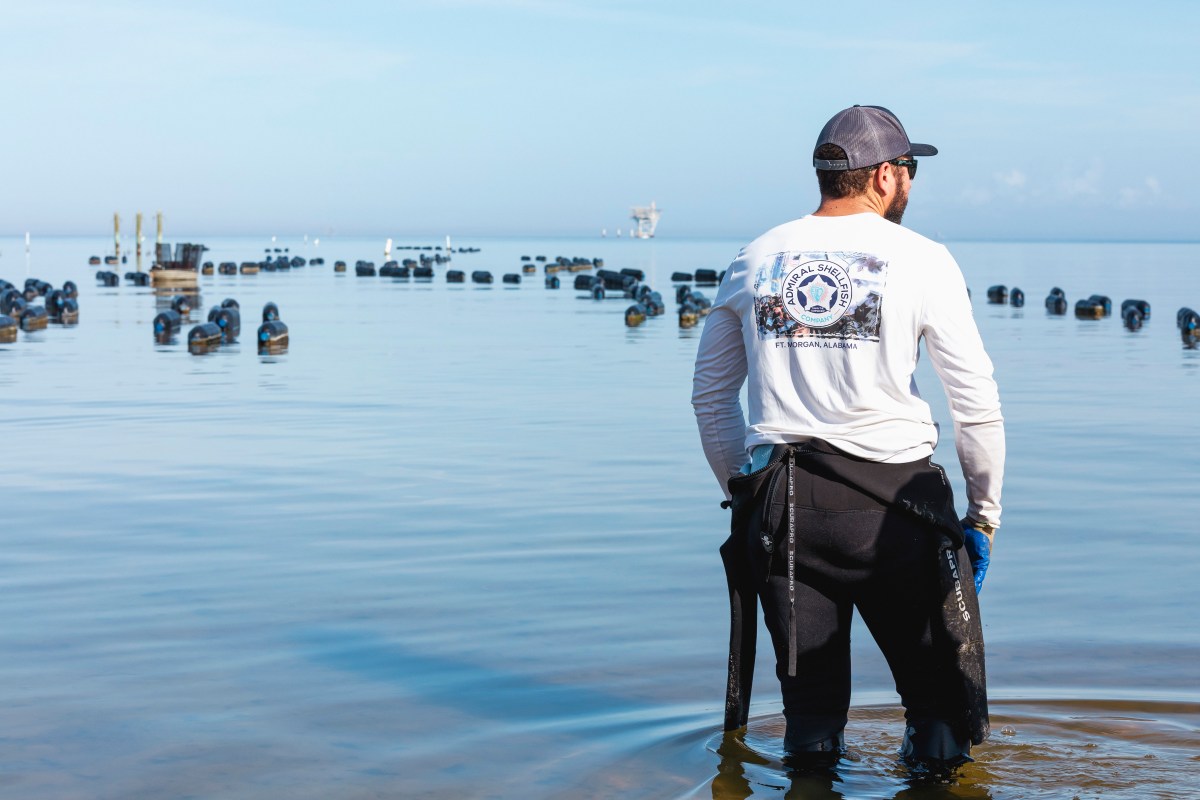
Approaching the farm’s shore you are greeted by Joe Ingraham, a bearded oysterman and great storyteller. He looks like “a pirate, 200 years too late,” as Jimmy Buffett might put it. The farm stretches out into the bay for 1,400 feet, and you can see black buoys rectangling in the sea. There are nearly 700,000 oysters growing in this space. It’s shallow and the Admiral team rarely has to use boats. It’s mostly waders when they’re out checking the cages.
Ingraham is on the farm every weekday. When you visit Admiral, and observe Joe and co-owner Anthony Ricciardone working the farm, you quickly learn this is not a project for dilettantes. Or the faint-hearted.
Ingraham is explaining the lay of the land to our photographer.
“When the cage is suspended, that’s exactly where they sit – in that top two feet,” Ingraham says. “But that also gives them protection from would-be predators.”
Ingraham and his team are constantly working with the oysters, shaking and handling and fine-tuning the bags. This is partly an effort to keep the “lip” off the shell, which is a form of curation that allows for better presentation. They also take the oysters out of the bag and let them air-dry, which helps kill off things like algae.
“In terms of a handcrafted product, we’re literally shaping the cup of the oyster. Our chefs want consistency, and they want the same branded product every day,” says Ricciardone. “With these cups, it looks like the meat is exploding out of the shell, so it makes a really cool table presentation.”
Ingraham pulls some oysters out of the water, shucks them, and shows us the contours of the cup. The point is clear.
“The fact that Admiral is concentrating that much on each cup of oyster, that is what puts their product above and beyond,” says Seth Temple, head chef at La Chat Noir, an acclaimed restaurant in New Orleans’ Warehouse District that serves Admiral oysters daily. “They’re bringing that saltier oyster that customers crave. The salinity levels are matching that of Prince Edward Island, which is extremely rare in the Gulf.”
But along Prince Edward Island, it can take three to four years to grow an oyster to market. At Admiral, they can grow an oyster to market in as little as six months, due largely to the warmth of the water, and other factors. In terms of putting Mobile Bay oysters on the global culinary map, this is an enormous advantage.
Read the rest of the article here.