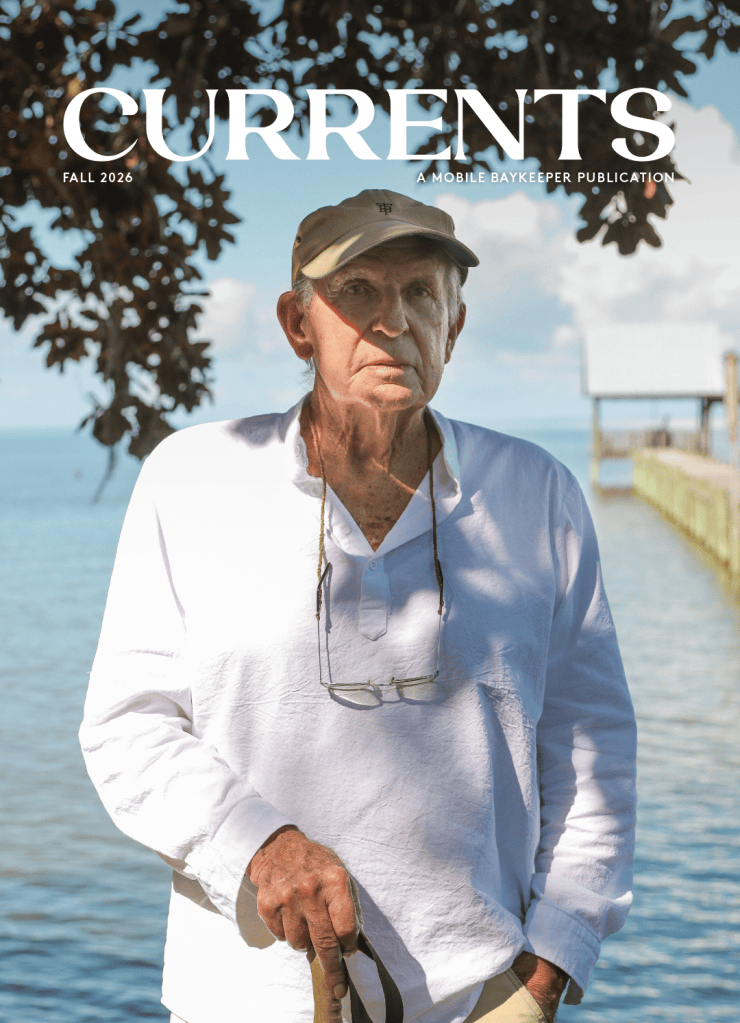
Jimmy, Jimbo, and the Moon Man 

This issue celebrates three Gulf Coast storytellers, including Jimmy Buffett, an honorary founding board member of Mobile Baykeeper.

Jimmy was born in Pascagoula, grew up in Mobile, and, after having little to no luck in Nashville, went on to chart his own path artistically—forging his own genre of music in the process and spawning an entire cultural movement. He took the Gulf Coast vibe we all know and love and sent it into the stratosphere. 

Buffett was an avid fisherman and conservationist—more so than many realize. He and Jimbo Meador, who appears on our cover, were old compadres—long before Jimmy became famous. Jimbo says Jimmy always wanted to fish in places no one else could get to and the two of them enjoyed angling for bonefish in the Keys and Bahamas over the years. Jimmy even name-checked Meador in the song “Mailbox Money,” where he sings about “gigging big fat flounder with Jimbo,” and declares that it’s one of the few pastimes that actually trumps the massive royalty checks he gets for his music. 

“We started going on those stand-up paddle boards to get in really skinny water that the guides couldn’t go to,” Jimbo tells Sam Wilkes about his fishing adventures with Buffett. “Did that right up to when he died. He loved bonefishing. I fished with him a lot. We used my design with the Ultimate Native kayak first. Because we wanted to get in that really skinny water, or back in those creeks. But anyway, I sure miss him, he was a helluva good friend and you know he never did forget me. I knew him before he got famous. That’s what most people don’t realize, he was down to earth.”

Jimbo is, among other things, known for designing prototypes for fishing kayaks and paddle-boards, and those contributions loom large in the world of fly fishing, where he remains an icon.

Jimbo’s son-in-law Dale Marston tells us that his eldest son inherited as much as he could from his grandfather. But Dale knows his boy did not grow up with what Jimbo had, and the fact that we’ve seen such a precipitous decline in the health of our waters in the span of one generation is a hard truth to confront.

Rounding out our trio of raconteurs is Don Green. A Delta fishing guru, Don holds court in his Saraland tackle shop and spins tales of the old days, back when the fish hauls ran in the hundreds.

The shop is filled with flies Don makes and sells at or below cost. It’s his way of giving back and getting youngsters into the game, as well as a way to impart the infectious joy of fishing. Like Jimbo, Don possesses a lifetime of knowledge on the water that is crucial to learn from as we work to build a better future for our waters. 

Nick Williams interviewed Don for this edition and Don has been a frequent guest on Nick’s podcast for Great Days Outdoors, “The Mobile-Tensaw Delta Fishing Report.” Don was a longtime columnist for Great Days and developed a cult-like following along the way. He is best known for his solunar “moon charts,” which he began making as a young boy, and which appeared in the back pages of the magazine for many years. 

When we greet Don outside his shed, just a stone’s throw from Bayou Sara, he’s wearing a purple t-shirt that says “The Rodfather,” which encapsulates his humor and persona to the hilt. It was a meaningful shoot for our photographer Courtney Mason, as Don is her grandfather. She grew up with weekend fish fries and a lot of tall tales around the dinner table. Most importantly, Don taught her about respecting the earth and living in balance with nature, and how, if that rule is followed, everything else will take care of itself.

Jimmy, Jimbo, and Don are engrossing storytellers, and their stories are more than entertainment. They are records of a watershed that has changed irrevocably in their lifetimes. What we take from those stories is up to us.

—Editor’s note, CURRENTS (Fall 2026)

The November Guests

November is not the cruelest month on Mobile Bay; in fact, it may be the best time of year. The weekend before Thanksgiving, my girlfriend and I kayaked and fished on the Blakeley River and around the marsh islands of the upper Bay. We’d never had much luck fishing the area in the funkier months of summer, but this time was different. We launched at Hooked Up by the Bay and paddled south on a cool midmorning, moving out past the Causeway and Bayway, mooring for a bit on the marsh islands that were dotted with heron and other waterfowl I could not name. In the distance to the West stood the RSA Tower and the container cranes of the Port that stretched across the skyline like great Mesozoic birds. From her kayak near the marshes Aryn harvested Rangia clams — also known as Cajun or cocktail clams — a muddy-tasting bivalve that never really caught on as a food source here and one that I would not be eating that night. We only had one fishing rod between us that day so we passed it among the kayaks and took turns casting, catching a bounty of redfish and flounder and baby croaker with miniscule live shrimp. And though the fish were not quite legal size — this part of the Bay is a nursery, after all — it was nice to see the Bay so alive with activity after so many bereft outings in the warmer months. When the fish are biting the hours dissolve into liquid and time is of no consequence. So eventually it’s not the clock that brings you in but a gnawing hunger and subsequent visions of Conecuh sausage and gumbo.

The water in the Bay now is clearer than it’s looked in years, the locals say. There’s been a drought this season, and while the water is generally less turbid in the winter months, the pause in dredging since August (to be picked back up this April) has likely contributed to greater water clarity. It’s a great time to be outside. And if fishing is not your thing, I recommend traversing the beaches of Dauphin Island in the early winter mornings and embracing your inner snowbird. Take your dogs to the Audubon Trail on the East End and let them cavort off-leash and swim in the Gulf if you’re alone. Like us they have nothing to lose but their chains. Dauphin Island is, of course, a bird sanctuary, and while the sightings were few during our trip there in late November there are still great opportunities for birding in the winter months. The cover story for this issue looks at the work of coastal biologist Olivia Morpeth with the Alabama Coastal Bird Stewardship Program, and what the organization is doing to preserve aviary habitats that are so critical to nesting, reproduction, and migration.

“These birds play an important role as indicator species for our coastal habitats” Olivia tells writer Sam K. Wilkes in his in-depth piece. “The presence of these birds, or lack thereof, can signal potential health issues in local coastal ecosystems … Monitoring these health factors is not only important for our local wildlife, but also for the people who live here and recreate in these waters.”

Not only are the birds important bellwethers of ecological health, they also drive ecotourism on the island, with some 400 species wending their way through this little spit of land in the spring and fall, making the island a sort of “ATL Delta hub” for our feathered friends. And with that come the visiting birders with their binoculars and a more focused attention on habitat preservation.

Indeed, everyone (fish, fowl, beast, or man) plays a part in our area’s ecological health, so if you’re not yet a member of Mobile Baykeeper, we ask that you consider joining this winter season, and becoming part of something bigger than yourself.

They Call Him Droopy

Every Delta fisherman knows Droopy Williams. Or at least knows of him. You’ve probably seen him as you’ve zoomed along the Causeway – a sort of roving landmark, sometimes in the waters above the highway, sometimes below. 

For nearly six decades he has been a shrimper for the bait shops along that raised ground between Spanish Fort and the city. I say shops. Once there were a dozen or more, but now there is only one. 

Droopy Williams grew up in the Delta in a cabin on the Tensaw River at Cloverleaf Landing. He was raised by his grandparents. Since he was a kid he has been called by that name. He says most folks don’t know his real name (don’t expect to get it here) but there is one who does – his aunt is Lucy “Pie” Hollings, proprietress of the Cloverleaf boat launch and a local Delta legend. The family lived off the land and water when he was growing up; crabbing, running trotlines, and raising hogs and cows on Gravine Island just across the river. They were different days indeed.

These days, driving into Mobile in the early morning hours you might catch him working the Blakeley River in his 24-foot trawler, the words LIVE BAIT painted in bold red lettering on the side. It’s a reassuring sight. For all the change behind us and all that lies ahead, no matter what comes you can rest assured that the sun rises, the sun goes down, and that Droopy is out there catching shrimp.

At age thirteen he went to work for Autrey’s Fish Camp, as soon as school let out for summer, and it was during those summer months that he first lived on the Causeway with Billy and Queenie Wright, who ran the shop. It was the mid-1960s and everybody fished. In those days you could rent boats by the hour at Autrey’s or Stauter Boat Works, and try your luck for redfish or trout on your lunch break. It was a sort of Golden Age, but of course all that changed in ’69 when Camille showed up like a woman scorned and let everyone know the party was over.

In his years on the water, Droopy has seen all manner of change. There has been sustained development, increased dredging operations, and an oil spill, to name just a few of the things that have left their mark. These days the shrimp are smaller and the fish are less plentiful. There are more gators and bald eagles, but less snakes. The hogs his family once raised on Gravine Island are no more, but their progeny now run wild and roam the woods of the upper Delta. There is only one bait shop left standing on the Causeway, for which he still supplies shrimp, and as Williams is a bait shrimper, not a licensed commercial operator, he can only sell directly to bait shops.

Droopy is the only Black shrimper on the local scene — a fact he seems to take pride in. He’s tried to take on numerous deckhands, but it’s tough work and most can’t cut it, so these days he prefers to work solo. He says he doesn’t mind going it alone though: every changing wind and tide is like a greeting from an old friend.   

Today he lives on Cloverleaf Landing, just up the road from where he grew up, shrimping in the morning and fishing for bream most afternoons, and he says there is no better place on earth to live.

We met up with him one cold, January morning at Cloverleaf when the tide was low. We couldn’t launch the boat, so we stood on the bank and heard his many tales of a life on the water.

— Read the rest in CURRENTS.