The November Guests

November is not the cruelest month on Mobile Bay; in fact, it may be the best time of year. The weekend before Thanksgiving, my girlfriend and I kayaked and fished on the Blakeley River and around the marsh islands of the upper Bay. We’d never had much luck fishing the area in the funkier months of summer, but this time was different. We launched at Hooked Up by the Bay and paddled south on a cool midmorning, moving out past the Causeway and Bayway, mooring for a bit on the marsh islands that were dotted with heron and other waterfowl I could not name. In the distance to the West stood the RSA Tower and the container cranes of the Port that stretched across the skyline like great Mesozoic birds. From her kayak near the marshes Aryn harvested Rangia clams — also known as Cajun or cocktail clams — a muddy-tasting bivalve that never really caught on as a food source here and one that I would not be eating that night. We only had one fishing rod between us that day so we passed it among the kayaks and took turns casting, catching a bounty of redfish and flounder and baby croaker with miniscule live shrimp. And though the fish were not quite legal size — this part of the Bay is a nursery, after all — it was nice to see the Bay so alive with activity after so many bereft outings in the warmer months. When the fish are biting the hours dissolve into liquid and time is of no consequence. So eventually it’s not the clock that brings you in but a gnawing hunger and subsequent visions of Conecuh sausage and gumbo.

The water in the Bay now is clearer than it’s looked in years, the locals say. There’s been a drought this season, and while the water is generally less turbid in the winter months, the pause in dredging since August (to be picked back up this April) has likely contributed to greater water clarity. It’s a great time to be outside. And if fishing is not your thing, I recommend traversing the beaches of Dauphin Island in the early winter mornings and embracing your inner snowbird. Take your dogs to the Audubon Trail on the East End and let them cavort off-leash and swim in the Gulf if you’re alone. Like us they have nothing to lose but their chains. Dauphin Island is, of course, a bird sanctuary, and while the sightings were few during our trip there in late November there are still great opportunities for birding in the winter months. The cover story for this issue looks at the work of coastal biologist Olivia Morpeth with the Alabama Coastal Bird Stewardship Program, and what the organization is doing to preserve aviary habitats that are so critical to nesting, reproduction, and migration.

“These birds play an important role as indicator species for our coastal habitats” Olivia tells writer Sam K. Wilkes in his in-depth piece. “The presence of these birds, or lack thereof, can signal potential health issues in local coastal ecosystems … Monitoring these health factors is not only important for our local wildlife, but also for the people who live here and recreate in these waters.”

Not only are the birds important bellwethers of ecological health, they also drive ecotourism on the island, with some 400 species wending their way through this little spit of land in the spring and fall, making the island a sort of “ATL Delta hub” for our feathered friends. And with that come the visiting birders with their binoculars and a more focused attention on habitat preservation.

Indeed, everyone (fish, fowl, beast, or man) plays a part in our area’s ecological health, so if you’re not yet a member of Mobile Baykeeper, we ask that you consider joining this winter season, and becoming part of something bigger than yourself.

Peter Frank and the Great Loop

What drives a person to climb Kilimanjaro or swim the English Channel? Why did Alexander Supertramp light out for the territories, only to meet his demise after ingesting the seeds of a toxic plant in the Alaskan wilds? Why did Huck Finn set sail on the Mississippi — was it to get away from the Widow Douglas and his abusive father, or was it something much deeper that called him down the river? Why do locals like Ryan Gillikin and Joseph Bolton kayak the Alabama 650 every year, pushing their bodies and minds to the point of exhaustion and delirium? And why did Forrest Gump decide to just start running?

It’s a mystery, folks. The biblical Cain was our first Great Wanderer, but he had little choice in the matter. After slaying his brother out in the boonies one fine autumn day, he was cast east of Eden, condemned to walk the Earth for eternity, branded with God’s own tattoo. 

Unlike Cain, today’s explorers will tell you they do have a choice — at least some of the time. But what drives them to set sail upon the dark waters and traverse the barbarous lands remains somewhat of a mystery, even to them. For its part, America has a long tradition of explorers and wanderers. The conquistadors of Spain got the ball rolling in the name of gold, God, and glory. Lewis and Clark (along with Sacagawea) traversed the western frontier at the behest of Jefferson, while Mason and Dixon settled some important boundary disputes with their jaunts. Voyaging is a big part of the national character, from Kit Carson in the Rockies to more intellectually prone seekers like John Muir and Edward Abbey. And then there are the cultural titans like Jack Kerouac and the Grateful Dead, whose legions followed in the literal footsteps of their journeys, forging a new kind of adventurer along the way.

Today’s explorers seem to be as much about the spiritual quest, and not as much about clapping eyes on new lands. For them, it’s a test of will, a feat of the heart. Perhaps this is because today’s voyages can’t help but look and feel a little different, now that we live in the time of GPS and mobile phones. Alaska may still be the last terrestrial frontier, but in the age of satellites, civilization is never out of reach in the way that it once was. What about that Mars trip we’ve heard so much about? Well, that might be a while. So perhaps it is that after centuries of settlement and industrialization, the American wilderness is all but erased, but the wilderness within remains.  

One of America’s great modern explorers is not a household name. He is a gentleman by the name of Verlen Kruger. A native of Indiana who lived in Michigan for much of his life, Verlen, who died in 2004, is credited with canoeing more miles than any other American — in excess of 100,000 miles. Somewhere in between the time of his relentless voyaging, he managed to design a specialty canoe, the Savage Loon, a thirteen-and-a-half-foot craft specifically tailored for long voyages. Reminiscent of a kayak, the Loon has all the tell-tale features of a traditional canoe in that the boat features a hollow shell with a raised seat and lacks the keel or fin found on most kayaks. With a cockpit more than eighty inches long, it was designed to be able to navigate rough conditions on extended treks. In canoe circles, the Loon is known as a “decked canoe,” meaning that the deck covers a portion of the cockpit — and indeed it is often mistaken for a kayak. 

In addition to his contributions to design (he funded his voyages by leasing his patent to commercial canoe-makers like Savage), Verlen Kruger is known for having logged one of the longest canoe jaunts in human history, a 28,000-mile odyssey across North America that came to be known as the Ultimate Canoe Challenge. This was a feat that found Verlen and his son, Steve Landkin, paddling the length of the Mississippi and Colorado rivers upstream as part of The Great Loop. That’s a pretty long haul against the current when you are clocking a 6,000-mile route. In 1981, Verlen and his son became the first to canoe the Great Loop in reverse, or clockwise, as one sees it on a map. 

“I’ve often thought about the results of making some of these big trips,” Verlen once said. “I haven’t done anything great for humanity; it was more that I’ve done something great for myself. But I do hear from other people who say they’ve been inspired by my travels. Hopefully, I can get them to look a little farther, a little deeper into themselves, into what they can do.”

The Great Loop is a circumnavigational route that winds through the eastern half of the United States (15 states) and parts of Canada (two provinces), taking “Loopers” through the Intracoastal Canal, the Great Lakes, the Gulf of Mexico, the Mississippi River, and a byzantine network of canals and rivers in between. Most undertake the voyage with a motorized craft, taking on average about a year to complete the journey, though it has been done in as little as six weeks. The great majority of voyagers elect to travel in a counter-clockwise direction, which allows them to move along with the currents, which can be especially helpful on powerful rivers like the Mississippi and Ohio. For the motorized set, the trip is typically one of leisure. The starting point is a matter of choice, but many opt to start in Chicago in the fall, which allows them to wind around Florida in the winter, when many parts of the northern route are closed. 

Read the rest at Mobile Baykeeper.

They Call Him Droopy

Every Delta fisherman knows Droopy Williams. Or at least knows of him. You’ve probably seen him as you’ve zoomed along the Causeway – a sort of roving landmark, sometimes in the waters above the highway, sometimes below. 

For nearly six decades he has been a shrimper for the bait shops along that raised ground between Spanish Fort and the city. I say shops. Once there were a dozen or more, but now there is only one. 

Droopy Williams grew up in the Delta in a cabin on the Tensaw River at Cloverleaf Landing. He was raised by his grandparents. Since he was a kid he has been called by that name. He says most folks don’t know his real name (don’t expect to get it here) but there is one who does – his aunt is Lucy “Pie” Hollings, proprietress of the Cloverleaf boat launch and a local Delta legend. The family lived off the land and water when he was growing up; crabbing, running trotlines, and raising hogs and cows on Gravine Island just across the river. They were different days indeed.

These days, driving into Mobile in the early morning hours you might catch him working the Blakeley River in his 24-foot trawler, the words LIVE BAIT painted in bold red lettering on the side. It’s a reassuring sight. For all the change behind us and all that lies ahead, no matter what comes you can rest assured that the sun rises, the sun goes down, and that Droopy is out there catching shrimp.

At age thirteen he went to work for Autrey’s Fish Camp, as soon as school let out for summer, and it was during those summer months that he first lived on the Causeway with Billy and Queenie Wright, who ran the shop. It was the mid-1960s and everybody fished. In those days you could rent boats by the hour at Autrey’s or Stauter Boat Works, and try your luck for redfish or trout on your lunch break. It was a sort of Golden Age, but of course all that changed in ’69 when Camille showed up like a woman scorned and let everyone know the party was over.

In his years on the water, Droopy has seen all manner of change. There has been sustained development, increased dredging operations, and an oil spill, to name just a few of the things that have left their mark. These days the shrimp are smaller and the fish are less plentiful. There are more gators and bald eagles, but less snakes. The hogs his family once raised on Gravine Island are no more, but their progeny now run wild and roam the woods of the upper Delta. There is only one bait shop left standing on the Causeway, for which he still supplies shrimp, and as Williams is a bait shrimper, not a licensed commercial operator, he can only sell directly to bait shops.

Droopy is the only Black shrimper on the local scene — a fact he seems to take pride in. He’s tried to take on numerous deckhands, but it’s tough work and most can’t cut it, so these days he prefers to work solo. He says he doesn’t mind going it alone though: every changing wind and tide is like a greeting from an old friend.   

Today he lives on Cloverleaf Landing, just up the road from where he grew up, shrimping in the morning and fishing for bream most afternoons, and he says there is no better place on earth to live.

We met up with him one cold, January morning at Cloverleaf when the tide was low. We couldn’t launch the boat, so we stood on the bank and heard his many tales of a life on the water.

— Read the rest in CURRENTS.

In the shadow of the spill

It’s been fifteen years since the Deepwater Horizon oil rig suffered a blowout and spilled five million barrels of crude oil into the waters of the Gulf of Mexico. The 87 days that followed the explosion on April 20, 2010 — forty miles off the coast of Louisiana — left residents gripped in a white-knuckle, teeth-grinding frenzy, as the slick continued to grow and approach the coast like some kind of atavistic, sci-fi horror show.

By the time The Great Blob was finally contained, it had affected 70,000 square miles of the Gulf, roughly the size of Oklahoma. It was the worst industrial disaster in U.S. history by volume. To this day, the extent of ecological damage is unknown.

At the time it went down, the explosion and its ensuing spill wasn’t nearly as surprising as BP’s seeming inability to stop it. Three months is a long time to watch Anderson Cooper report on scenes of sheer devastation coming out of your own backyard. Less than two months after the explosion, BP, who had leased the rig from drilling contractor Transocean, had even stooped to soliciting suggestions on its website for ways to stop the flow. 

For anyone who loved the Gulf and called it home, or had even enjoyed a Bushwhacker at the Flora-Bama during a Spring Break in the long ago, the spill was a major wake-up call. There was a period in those three months where Life As We Knew It on the Gulf Coast might conceivably be over. 

Thankfully, that didn’t happen. Fifteen years later, we are more vigilant about threats to our waters, and, in many ways, ecological efforts are more robust. The 2012 RESTORE Act helped lead remediation efforts, and NOAA has been stalwart in their efforts at restoration. Safety standards have reportedly improved at rigs since the Deepwater Horizon. But are we truly protected from another major spill — who knows? 

Ninety-seven percent of offshore oil and gas drilling in the U.S. happens in the Gulf, and, currently, only a fifth of the Gulf’s 2,200 active leases are in operation, due to a large production supply and the high costs of drilling, according to the Bureau of Ocean Energy Management, a federal agency that manages offshore drilling. 

It’s clear that drilling in the Gulf will be around for some time. Let’s hope the regulatory framework remains intact as well. We have too much to lose.

— from CURRENTS (SPRING 2005)

Built to last

My dad bought his Stauter in 1984. He got it from a guy who worked at Delchamps on Old Shell Road who was pulling up stakes and moving to New Orleans. It was a 16-foot, 1966 Aqua Queen, painted in two-toned black and white with a racing stripe indent on the upper hull. He paid less than a princely sum for it.

It was the second Stauter made that year. The serial number on the keel reads 660002.

I don’t remember him buying the boat as I was only five years old at the time. But I do recall my time in it during the ensuing years. I have vivid memories of learning to ski behind it on Cypress Garden trainers at Point Clear, not far from the Grand Hotel. I remember seeking shelter under the bow as we raced back from Sand Island on summer afternoons — when thunderstorms would appear out of nowhere and turn the skies from blue to black in the space of a Steely Dan song, threatening death-by-lightning-strike. I can still smell the salt and mahogany under the bow and hear the sound of the waves slamming into the boat with a ferocity that was, I believed at the time, certain to leave us shipwrecked. Indeed this was not a craft made for easy rides on the storm-tossed sea. But nothing ever happened and in its 40-year history with my family, the boat has never sprung a leak.

In my first years on the water I don’t think I was aware of any boats other than Stauters. All my parents’ friends had them (mostly the popular 15-and-a-half-foot Cedar Point Special model). Stauters were to the Bay what oak-paneled Chevy station-wagons were to the parking lot of the A&P — they were everywhere. I do recall the first time I rode in a Boston Whaler and being thoroughly unimpressed, disgusted almost. The boat was cold, impersonal, and just plain ugly — a symbol of the overly efficient, industrial North. All utility and no style. And what was with this fiberglass stuff? The Stauter had elan; it was a patriot of our seas.

The history of Stauter Boat-Works has been told elsewhere, most eloquently in a Wooden Boatmagazine profile from the early ’80s. The company was started in 1947 by Lawrence Stauter and taken over by the Lami Brothers (the grandsons of Lawrence’s first-cousin) in 1979. The old boat works stood on the Causeway (you could rent Stauters for the day back then) until Hurricane Frederick showed up and reminded everyone who was in charge. In its heyday, Stauter was building an impressive 400 boats a year — and all of them by hand. The Lami Brothers continued to build the boats at the new location on Three Notch Road in Tillman’s Corner for another thirty-one years. Production ceased in 2010.

My father’s favorite memories of the Aqua Queen revolve around family and friends, of teaching us to ski behind it, as well as teaching the next generation of grandchildren. He has fond memories of taking it up into the Delta with friends in the ’80s and ’90s and finding the redfish honey-holes that seem so much harder to locate these days.

The Aqua Queen is not as ubiquitous as other models like the Cedar Point Special, and it draws inquiring looks as we cruise the bays and creeks around Perdido Beach and Josephine. It is a show-piece that is not ready to retire. In 2009 it placed third in the Pirates Cove Wooden Boat Festival — a contest that mostly features touring show-boats on trailers.

“I get a lot of thumbs up on the water, and that’s about it. And a lot of waves,” my dad says when asked about the reaction the Aqua Queen elicits these days. “I once got stopped by the marine police. I wasn’t doing anything illegal. He just stopped me because he wanted to look at the boat.”

— from Mobile Baykeeper’s CURRENTS.

Point Clear in the ’80s: A Remembrance

Point Clear was a special place in the 1980s. It was a kids’ paradise. It’s where you learned to ski, pop a wheelie, and fight without really hurting your opponent. It is where you learned to operate a Stauter. You wore Jams shorts and carried Throwing Stars in your pocket and you knew for a stone-cold certainty that the Soviets were your enemy. 

I remember the unmistakable scents of honeysuckle and wisteria, Capri-Suns and Hawaiian Tropic suntan oil. The town dripped with atmosphere, and the damp air wrapped around you like a blanket. The live oaks that lined the Bay — writhing, ancient grotesques with arms that twisted and dipped over the boardwalk, nearly touching the sand — we scrambled barefoot over, like spider monkeys crazed on sugar. They are the best trees in the world for climbing and the Bay opened up to the sky with its promise of a never-ending day. 

In those long, amphibious summers we spent as much time in the water as on land. No one would have been surprised if one of us had sprouted fins. On some instinctive level the water represented freedom and a sense of possibility that you did not have in Mobile. Even as kids of six or seven, we understood the significance of what we had. 

The Bay was still the color of chocolate milk along the boardwalk in Point Clear. I don’t remember any talk from the parents about the Bay being unhealthy. Swimming with cuts on your knee — a near constant — was never cause for concern. But I do recall the dads wearing T-shirts that read “Mobile Bay: Together We Can Keep It Alive.” And the Bay was alive. That it could be otherwise was an ominous impossibility, edged far on the periphery, along with the sense that something precious could be lost. 

Hit It 

Learning to ski was a rite of passage that dominated the agenda in the early days of summer. Ski school started early and the moms were the instructors. They ran a tight ship. Every kid had to learn to ski and there was no such thing as a pass. Tubing had not yet entered the picture and though hydro-sliding was popular it was very much on the side stage. When it came to skiing, there was definitely a sense of competition over who could get up first. 

We learned on four-foot, yellow Cypress Garden trainer skis that were fastened together with a rope. One of the moms, the one not on boat duty, was positioned in the water to hold you steady and give you an extra shove. When you gave her the go-ahead she’d yell “hit it” and the driver would floor the Stauter. 

Once you got up on trainers, it was difficult to dart in and out of the wake, and there was not a lot of opportunity for showing off.  You mostly just glided along with your thoughts and waved to idlers on their wharves until your arms got tired and you finally quit. Once we learned on real skis, we were certain it would be a different story. 

Catfish Pond 

Fishing off the wharf was a daily enterprise. For bait we used mussels we’d managed to dig out from beneath the surface of the Bay, cracking them open with a hammer to get to the meat. We fished with brightly colored Zebcos purchased at the mini-mart down the road. Spinning rods and reels were reserved for the dads. We dared not use those and risk getting the lines all tangled and cattywampus, which would have incurred their wrath. 

We mostly caught catfish in those summers. There was a section near the end of the wharf — the wharves were rickety and weathered then and not like the showpieces you see today — which we named Catfish Pond. You would catch one there every time. One night my granddad stepped on one and got an infection in his foot from where it finned him. Naturally, we vowed revenge. From then on any catfish we caught was summarily bludgeoned and used as bait for the crab-traps. Beaver, the family golden retriever, looked on with bemusement. Our methods were wantonly cruel, but it seemed right at the time, convinced as we were of the collective guilt of catfish. 

I don’t recall any redfish being caught. Occasionally one of the kids would snag a speckled trout, and once someone caught a flounder with a grape. The incident bloomed into a folk legend that continues to this day. 

The Bells 

I remember hearing the bells at dawn, heralding a jubilee, something I’d long heard about. A few hours later the Igloos were running over with crabs and flounder. What the hell did we do with all that food, I wonder? The anticipation of the bells was like listening for the sound of reindeer hooves the night before Christmas. 

Keys to the Boardwalk 

When we were not on the water, we were on our bikes. Our turf stretched along the boardwalk from the Grand Hotel all the way to the Punta Clara Kitchen candy-store (where, we were convinced, there lived a witch). I don’t remember ever having to check in except for lunch and dinner. These were not the days of helicopter parents. I don’t think anyone ever got hurt or lost, and the ice-cream man was not someone to be feared. 

The movie Rad had done for kid bike-culture what Karate Kid had done for the martial arts. I rode a candy-red Mongoose, my prized possession. Not the fastest ride on the street but it got the job done. It was decked out with pegs and wheel-spokes the color of Skittles. I rode it proudly, without a helmet of course. 

We rode to the gas station next to the Grand Hotel to buy baseball cards, the coin of the realm back then. At the time a pack of cards (15 cards, 55 cents) came with a stick of pink gum that tasted like cardboard. You traded cards constantly, carefully weighing each negotiation and never entering into a trade without anxiety. There were a few instances of alleged theft, including one involving the then-coveted 1987 Topps rookie card of Andre Thomas, a now-forgotten Braves shortstop. 

May the Best One Win 

It was not all about the kids. The parents had their share of fun, to be sure. And the fun was not always rated PG. At some point in every summer, a group of moms, sporting short hair and the oversized, tinted sunglasses that were fashionable at the time, took part in a competition known as “The Boob Contest.”

This atavistic ritual involved the contestants standing up and performing gyrations while balancing on a black inner tube, Miller Lites and cigarettes in hand, topless as Woodstock in the pagan days of yore. This was not something we kids witnessed, but being kids, we had caught wind of it. Although it may have been hidden from our sight it did take place in the bright light of day under the watchful eye of God. Not sure if there was a single presiding judge or if a committee was appointed, but the winner was awarded a plastic gold trophy of a single, naked boob. 

Adventures in Babysitting 

The teenage baby-sitter was an important personae in this drama. Casting usually involved a girl of 12 or 13 — cheap labor for the parents. The babysitters, for the most part, were generally cool and not strict disciplinarians. They taught us jokes above our reading-level and gave us lessons on gender-bending by way of Boy George’s music. There was one bad apple in the mix, however. He was a guy of about 15 who drank Budweiser longnecks in tandem on the wharf while we slurped Kool-Aid and cannonballed into the water throughout the hot afternoon. We were quite disturbed by his prodigious beer consumption. When we asked him how old he was he just replied “old enough.” He was fired but no charges were pressed. 

The Fry House 

One summer my family stayed at the Fry House. I’ve been told that it served as an ad-hoc hospital for soldiers during the Civil War. It stood on the boardwalk about 13 houses down from the Grand Hotel and at the time it was one of the more decrepit edifices facing the Bay — a planter’s version of the Boo Radley dwelling. There was no air-conditioning that summer. I recall the whir of enormous ceiling fans, endless PB and Js, the flare of heat lightning over the Bay, and a black-and-white television playing Braves games and the videos of George Michael and Crowded House on constant rotation. 

Epilogue 

Summers die, but the memories don’t. I’m grateful for my child- hood summers spent in Point Clear. To this day they come back in the Technicolor of my imagination, clear as the jubilee bells at dawn.

— from Mobile Baykeeper’s CURRENTS.

The Bay Is Your Oyster

If you ask any first-class gourmand where to find the best oysters in the world, they will tell you to look in the claires of France or along the western coast of Ireland. Certainly in the shallow waters around Prince Edward Island in the Gulf of St. Lawrence, or in Wellfleet Harbor, Cape Cod. Somewhere in the Gulf of Mexico? Not a chance. 

If they are really savvy, they will tell you about Mali Ston Bay, an oyster utopia on Croatia’s Dalmatian Coast where a variety of European flat oyster can be found that is so precious Roman emperors once funded commercial farms there, and still, two millennia later, Austrian emperor Franz Joseph was insisting that his monthly shipments to Vienna come from Mali Ston alone. In Franz Josef’s day, five hundred miles by train would be about the same as shipping overnight on a 747. In logistical terms, halfway around the world. 

Such is the love for this strange and wonderful bivalve and the lengths we will go to get them — nowhere is too far to send for the best. So whether you take them by the dozen on the half-shell or fried on a po-boy, with a bottle of France’s sparkliest or with an icy schooner of what made Milwaukee famous, the humble and posh oyster inspires a love that runs deep into the heart of many cultures and culinary traditions. 

The Gulf, however, has not enjoyed the same reputation for quality as these other fabled appellations. Even before the concerns brought by the BP oil spill, there was the long-held conception that the Gulf waters are too warm and turbid, and that the coastal beds where our oysters develop their unique flavor profile are not briny enough. 

So what we always lacked in quality, we made up for in quantity. At least we did until BP, an event that wiped out somewhere between 4 to 8 billion oysters — a loss that has taken the mollusk three generations to replenish. 

As recently as 2019, the U.S. Department of Commerce designated Alabama as one of several Gulf states whose seafood had been greatly endangered. 

Hard numbers and the effects of the spill aside, such conceptions about the Gulf’s fitness for growing world-class oysters are not the whole truth. The key to growing a world-class oyster is not in a body as large as the Gulf or even as small as a single bay. And as bad as the spill was, is, the waters are healing. In beds that may be only as large as a few acres, the perfect conditions can and do exist. If only you know where to look. 

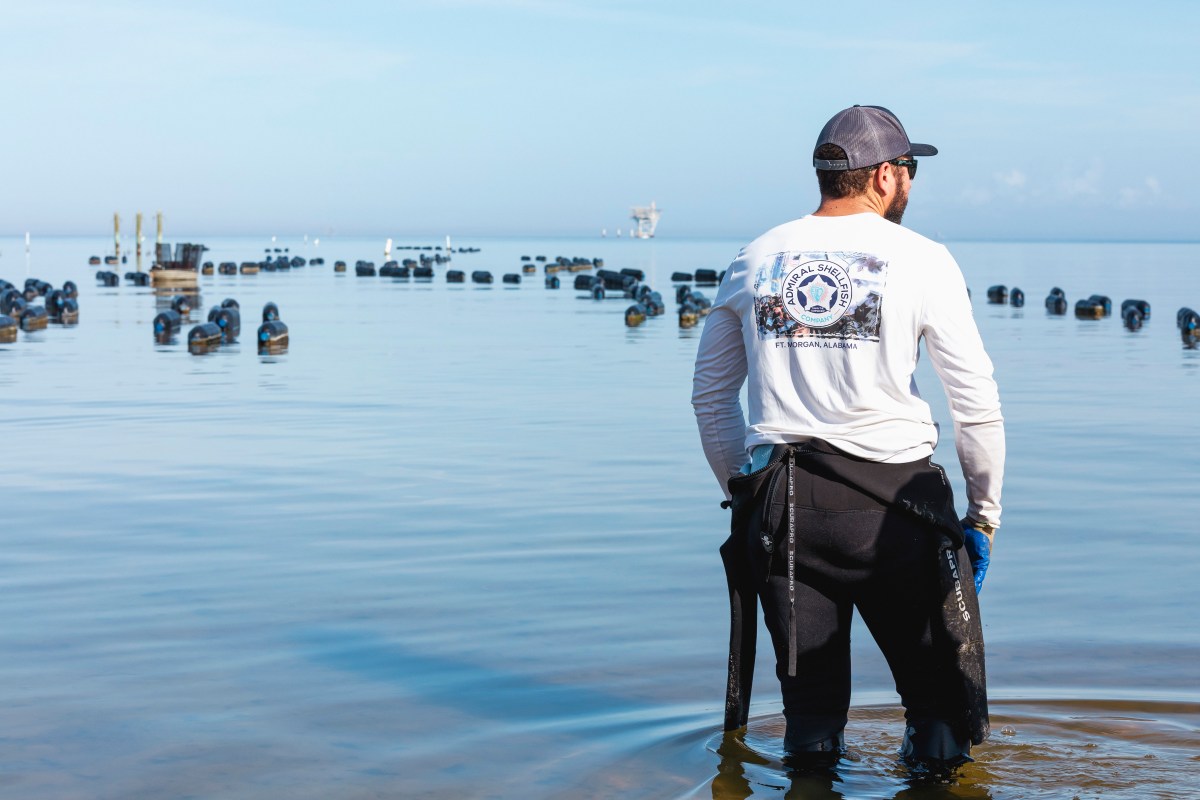
I visited the Admiral farm in early December. The morning had brought a low tide. Through the slash pines and saw palmetto at the farm’s approach, which sits just off Fort Morgan Road near the marina, you can already see it. The water is clear; so clear you feel as if you’re glimpsing the sandy bottom through a fish tank. 

Nearby, about 300 yards from Fort Morgan, the remnants of the Tecumseh, the Union warship that capsized after striking a mine during the Battle of Mobile Bay, is buried beneath the Bay. The farm works with the state to ensure the site remains undisturbed. Thus the name, Admiral Shellfish Company, replete with its “damn the torpedoes” ethos. 

This is Mobile Bay, I have known it my whole life, and while the water is typically less turbid during the winter months, this locale seems by contrast a different waterbody altogether from the caramel hues of the river-fed upper Bay. Here, the diurnal tide ushers in full-strength ocean water, and there is no siltation. On the hottest day of the year, the waters might reach 84 degrees, only slightly warmer than the near 80 degrees seen in Mali Ston. 

As a general rule, the perpetually brackish Mobile Bay averages 10 to 20 parts per thousand (PPT) for salinity. Because of the diurnal tide, however, the coveted 20 to 24 PPT salinity level is a near constant at the farm. On the day of my visit the salinity level is at 23. Scarce rain in October and November meant the farm never went below 25 in those months. 

So here, at the southern end of the Bay where the Gulf currents, underwater terrain, and surrounding geography converge in a swirl of exceptionally clear, highly saline waters, the ideal conditions exist for growing world-class oysters. In waters saturated with just the right concentration of minerals, nutrients, and phytoplankton, amid these conditions there exists some of the best that can be found, anywhere on earth. 

***** 

Approaching the farm’s shore you are greeted by Joe Ingraham, a bearded oysterman and great storyteller. He looks like “a pirate, 200 years too late,” as Jimmy Buffett might put it. The farm stretches out into the bay for 1,400 feet, and you can see black buoys rectangling in the sea. There are nearly 700,000 oysters growing in this space. It’s shallow and the Admiral team rarely has to use boats. It’s mostly waders when they’re out checking the cages. 

Ingraham is on the farm every weekday. When you visit Admiral, and observe Joe and co-owner Anthony Ricciardone working the farm, you quickly learn this is not a project for dilettantes. Or the faint-hearted. 

Ingraham is explaining the lay of the land to our photographer. 

“When the cage is suspended, that’s exactly where they sit – in that top two feet,” Ingraham says. “But that also gives them protection from would-be predators.” 

Ingraham and his team are constantly working with the oysters, shaking and handling and fine-tuning the bags. This is partly an effort to keep the “lip” off the shell, which is a form of curation that allows for better presentation. They also take the oysters out of the bag and let them air-dry, which helps kill off things like algae. 

“In terms of a handcrafted product, we’re literally shaping the cup of the oyster. Our chefs want consistency, and they want the same branded product every day,” says Ricciardone. “With these cups, it looks like the meat is exploding out of the shell, so it makes a really cool table presentation.” 

Ingraham pulls some oysters out of the water, shucks them, and shows us the contours of the cup. The point is clear. 

“The fact that Admiral is concentrating that much on each cup of oyster, that is what puts their product above and beyond,” says Seth Temple, head chef at La Chat Noir, an acclaimed restaurant in New Orleans’ Warehouse District that serves Admiral oysters daily. “They’re bringing that saltier oyster that customers crave. The salinity levels are matching that of Prince Edward Island, which is extremely rare in the Gulf.” 

But along Prince Edward Island, it can take three to four years to grow an oyster to market. At Admiral, they can grow an oyster to market in as little as six months, due largely to the warmth of the water, and other factors. In terms of putting Mobile Bay oysters on the global culinary map, this is an enormous advantage.

Read the rest of the article here.

Causeway Chronicles: Tales From A Storied Parkway

Finnell Forrest has been fishing off the Causeway in the Mobile-Tensaw Delta for nearly a decade. His dad, who gave up fishing years ago, started taking him here when he was a kid.

At this little spot on the Blakeley River, not much more than spitting distance from the Causeway, Forrest and his buddy David Stallworth angle for largemouth bass, brim, crappie, redfish, and speckled trout. But no black drum — they let that go. “Too many worms in them,” he says.

Finnell likes fishing in the spring and fall best. He watches the tidal calendar and prefers fishing this locale to a falling tide. “The Blakeley is a pretty spot,” he says. “I get in my boat sometime and go up the river a bit. It’s a 17-foot-center console called a Bayhawk. It’s my first boat.”

On most days, Finnell uses a spinning rod with a J-hook and cork, with about three to four feet between bobber and hook. “[These freshwater fish] don’t eat down, they eat up,” he says. “They’re an ambush fish so they have to look up at their prey and eat them.” Today he and David are fishing with shiners and live shrimp they picked up at the bait shop just down the road, “Hooked By The Bay,” the last of its kind on the Causeway.

After a day on the water, Finnell cleans his haul at home and fries them up, using a mixture of cornmeal and wheat flour, and that seems to work pretty well, he says. Pan-fried mostly. Sometimes a deep fry. Baked occasionally. 

Asked what he likes most about fishing the Delta, he says it’s “the relaxation, the wildlife. It’s peace of mind.” 

But even among the scenic splendor, threats loom. From the patio of the Bluegill Restaurant, where I find myself later — just a hop, skip and a jump from Finnell’s fishing spot — you cannot see the candy-striped smokestacks of Plant Barry rising twenty miles away in north Mobile County, at the site of Alabama Power’s 600-acre coal-ash pond. The back-end of the restaurant, which sits on the eastern portion of The Causeway in Spanish Fort, looks out over Pass Picada channel — a veritable honey-hole for redfish, speckled trout, and largemouth bass— before flowing into Chacaloochee Bay. Families stand along the rickety dock after dining and kids angle for privileged glimpses of alligators loitering idly for scraps.

Standing along the Pass in the magic hour, among the cattails and cordgrass, hyacinth and lotus blooms, it’s easy to forget the elephant that looms northward in the Delta. Before the 2008 coal-ash spill in Kingston, Tenn. — a spill that resulted in nearly $3 billion in damages, and the deaths of cleanup workers — the issue of coal ash was not part of the public imagination.

Over the past seven years, due to the work of Mobile Baykeeper and others, coal ash is now very much on the minds of coastal Alabamians. And there are other threats you’d soon as well forget, as you soak up the Amazonian wonder: things like the BP oil spill, the dangers posed by dredging, and the increased stormwater runoff brought on by rapid development. 

In the lower reaches of the Delta, where it traverses the Causeway and flows into Mobile Bay, there are no fish consumption advisories issued by the Alabama Public Health Department. But northward along the Mobile River, at the Cold Creek location, the state advises that no species of fish be consumed due to mercury contamination.

At David Lake, also on the Mobile River, advisories are issued for largemouth bass and black crappie. It’s worth noting that if a location or species does not have an advisory, it means there is not enough data on that site, not that it is automatically safe to consume fish from there. So it stands to reason that a largemouth bass, or black crappie, or any freshwater fish coming from up river and traveling to the lower Delta, is likely at risk for contamination. For subsistence fisherman who rely on those fish to feed their families, that’s not good news. 

Read more at Mobile Baykeeper.

It’s All Connected: A Q&A With USA’s John Lehrter

“We’ve been very blessed in Alabama. We’ve traditionally had low population density in the watershed. One of the reasons I love living here is just being able to get up in the Delta. Ten minutes from here and I can be in this vast wilderness that is not only aesthetically beautiful but also providing all of these essential life-support services for humankind and I think we take that for granted. But it’s not a guarantee that it’s going to be there in the future. So I think the average citizen just needs to be aware that we’re all connected to this, and that there are limits to growth and how much humans can exploit our resources.”

Read the interview on Mobile Baykeeper.