“We’ve been very blessed in Alabama. We’ve traditionally had low population density in the watershed. One of the reasons I love living here is just being able to get up in the Delta. Ten minutes from here and I can be in this vast wilderness that is not only aesthetically beautiful but also providing all of these essential life-support services for humankind and I think we take that for granted. But it’s not a guarantee that it’s going to be there in the future. So I think the average citizen just needs to be aware that we’re all connected to this, and that there are limits to growth and how much humans can exploit our resources.”
Here at Mobile Baykeeper, we talk about our responsibility to future generations. How it is our duty to protect the bounty of the Mobile Bay Watershed for our children and grandchildren, so that it may sustain them in the same way it has sustained us in our lifetimes. This is what drives much of our work.
What we don’t talk about as much is our responsibility to the past — to the history, ideal, and natural perfection of what came before. When the first Spaniards showed up on the Gulf Coast in the early 16th century, this stretch of land must have been something to behold. It was an exotic clime (the French eventually called it a “trembling land”) that no doubt elicited a WTF moment, and settling here, in the case of the French a century later, was no picnic. Just ask the Cassette Girls of Fort Louis, who arrived in 1704 fresh off the boat from Paris. They arrived at Twenty-Seven Mile Bluff, the French equivalent of Jamestown, and found themselves living in a Hank Williams Jr. song (“Country Boy Can Survive”), likely skinning bucks and running trot-lines.
As local naturalist and author Ben Raines points out, Alabama remained untouched by the glaciers of the last Ice Age, a fact that accounts for our wealth of biodiversity and the darkly romantic aesthetic of our delta, one of the country’s last great wildernesses. Our patron saint of the sciences, E.O. Wilson, famously dubbed it “America’s Amazon.”
“Warmest climes but nurse the cruelest fangs,” Herman Melville once wrote. Today’s cruel fangs are not the smallpox and yellow fever that ravaged the colonists and natives of old, but — aside from hurricanes and floods — come in the form of pollution, notably the Plant Barry coal-ash pond that corrupts our groundwater and puts our region at such great risk.
Of course, there are other pollution culprits: excess nitrogen from runoff, PFAs, PCBs, etc. And they’ve all left their mark.
“All these people that are moving here, they ain’t got any idea what a paradise we used to have,” Jimbo Meador, our local version of Huckleberry Finn, told Mobile Baykeeper last year. “They have no conception of what Mobile Bay used to be like. And you know, it is a dying breed that remembers what it used to be like. And so, it’s hard to fathom for some people, but I used to spearfish in Mobile Bay. I mean it was that clear. I used to put on a mask and snorkel and fins and I used to chop barnacles off of the pilings and spear sheepshead and even flounder and stuff.”
You can never return to the past; it’s a fool’s errand to try. But it takes a herculean effort not to squander all the good stuff, and to keep the rock we’re pushing up the hill from rolling back down on us. And while much has been lost, a lot of good remains. We still have quite a treasure among us. Perhaps if we can stop the pollution our waters can begin to heal.
— Caine O’Rear, Communications Director, on behalf of the Baykeeper Team
From the patio of the Bluegill Restaurant, you cannot see the candy-striped smokestacks of Plant Barry rising twenty miles away in north Mobile County, at the site of Alabama Power’s 600-acre coal-ash pond. The back-end of the restaurant, which sits on the eastern portion of The Causeway in Spanish Fort, looks out over Pass Picada channel — a veritable honey-hole for redfish, speckled trout, and largemouth bass— before flowing into Chacaloochee Bay. Families stand along the rickety dock after dining and kids angle for privileged glimpses of alligators loitering idly for scraps. Elvis likely stood here during one of several Bluegill experiences in the ’50s, perhaps after the time he performed at a Vigor High School assembly, only to have the show cut short due to the saltiness of his below-the-belt gyrations.
Standing along the Pass in the magic hour, among the cattails and cordgrass, hyacinth and lotus blooms, it’s easy to forget the threat that looms northward in the Delta. Before the 2008 coal-ash spill in Kingston, Tenn. — a spill that resulted in nearly $3 billion in damages and cleanup costs — the issue of coal ash was not part of the public imagination. Over the past seven years, due to the work of Mobile Baykeeper and others, coal ash is now very much on the minds of coastal Alabamians.
If you’re not privy to the news, you can learn why Mobile Baykeeper and the Southern Environmental Law Center filed a Notice Of Intent To Sue Alabama Power for its plans to leave more than 21 million tons of coal ash buried along the Mobile River, a historic body of water that was designated by American Rivers as the “third most endangered river” in the U.S. in 2022. Litigation has always been a means of last resort for Mobile Baykeeper, and these recent events are no exception.
In this time of global upheaval and cataclysm (both actual and imagined), when all seems so transient and short-lived, we have the chance to ensure a vital corner of our world, and one of national significance no less, is preserved and protected just as it should be. As always, we can’t do it without your support.
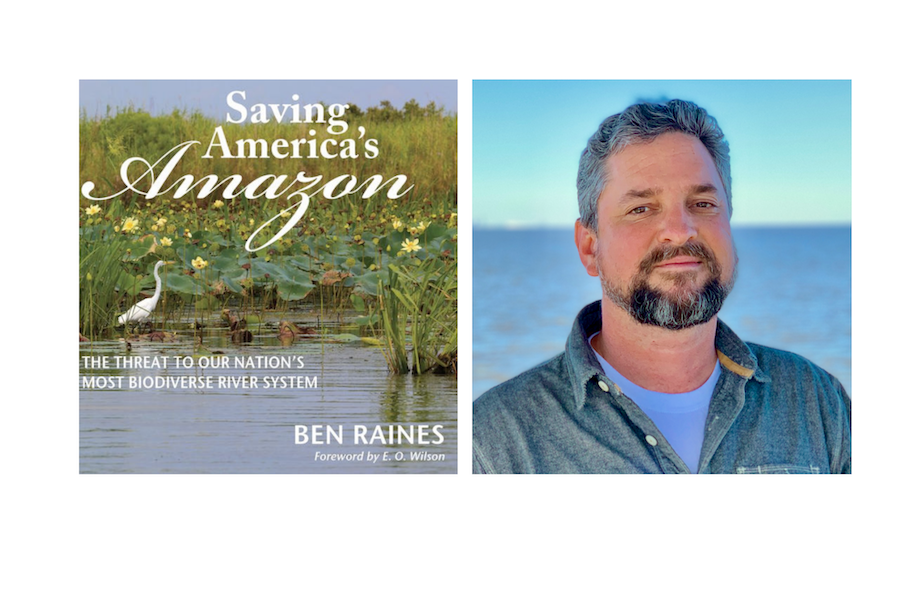
A writer, naturalist, and filmmaker, Ben Raines has been reporting on environmental affairs in Alabama for most of this century. As a former journalist for the Press-Register, he served as our region’s foremost environmental watchdog. Since leaving the paper, he has worked in film, authored books and scientific papers, and served as the executive director of the Weeks Bay Foundation, an environmental non-profit. His 2017 documentary about an ancient underwater cypress forest in the Gulf of Mexico, The Underwater Forest, was broadcast on public television, and other footage he’s shot has appeared on the Discovery Channel and National Geographic TV. In 2018, Raines made history when he discovered the remnants of the Clotilda, the last American slave ship, at the bottom of the Mobile River near Twelve Mile Island.
On December 12, Raines will release his latest offering to the world, Saving America’s Amazon, via New South Books. The book, which includes a foreword by eminent biologist and Mobile native E.O. Wilson, examines the rich biodiversity of the Mobile River Basin (a.k.a. “America’s Amazon”) and the environmental threats it faces as a result of pollution, increased development, and unscrupulous decisions by industry and elected officials. Yet despite a poor environmental record, Alabama still boasts more species per square mile than any other state.