Born on the Bayou: Generational Shrimpers Say Industry is Facing Existential Threat

It’s Saturday morning in Bayou La Batre and the crew from SeaHarvest Shrimp is busy.

It’s Saturday morning in Bayou La Batre and the crew from SeaHarvest Shrimp is busy. Perseverance, the company’s 63-foot shrimp boat, has just returned from a three-day trip in early July, shrimping the night waters of the Bay and Gulf. Within hours of mooring they begin selling their catch to the public — straight off the boat, directly into buckets and coolers for three dollars a pound. In a matter of hours, the entire catch will be gone.  

“You find some more fresh than this, you let me know where you got ‘em,” says James Hunter. By the way he says it, he knows one cannot. A resident of nearby Irvington, he is a devoted customer, and now he is watching on as Perseverance crew member Jaylen Hall, a mid-twenty-something who grew up in the trade, shovels several pounds of brown shrimp into his ice-filled cooler. One hopes this will be enough shrimp to tide him over for the week. A former restaurant worker, he knows his way around the kitchen, especially when it comes to shrimp. Boiled, fried, prepared à la scampi, simmered in a gumbo, you name it, he can cook it.  

Fresh seafood, of course, is essential to the culture of Coastal Alabama. It’s part of our way of life. Yet this piece of our heritage is quickly slipping away. For the last two decades, the production of farmed shrimp in the Asia-Pacific region has grown at a staggering rate of 20 to 30 percent per year and the United States is one of the largest markets for this new supply. With the surge of imported shrimp our own shrimping business has come under existential threat, particularly in the past decade. In this new scenario, it is customers like James who are keeping the Hall family in the shrimping business.

SeaHarvest is a family-run business, operated by shrimper Reed Hall and his wife, Tammy. They started their retail operation back in 2020, not long after Covid dealt its first blows to so many businesses of every kind. The family bought the lot by the drawbridge in Bayou La Batre in August of that year, after most of the shrimp boats in town had shut down. They started selling directly to the public as a way to stay in business and keep the home fires burning. “Covid really blessed us in a way,” says Tammy, who runs the business side of things for SeaHarvest, “because it caused us to have to take a whole different route.”

Before that, they were selling directly to the processors and factories in town for less than the three-dollar retail price, which is no longer sustainable. Financial viability is a problem for shrimpers in Alabama and the Gulf Coast. Studies vary, but some reports put the percentage of shrimp imported into this country as high as 90 percent of the total supply. These imports drive down the price of wild-caught, domestic shrimp. 

The situation has grown so dire the city of Bayou La Batre issued a Declaration of Disaster for the town’s shrimping industry back in August. Henry Barnes, the town’s mayor, says the Seafood Capital of Alabama is in danger of becoming a ghost town due to the moribund state of the shrimping industry. He wants the federal government to put an end to the high volume of imported shrimp that are “dumped” — or sold at less than fair-market value — into the U.S. market. He’d also like the government to subsidize fuel for shrimpers. 

Eighty-five percent of the wild-caught shrimp in Alabama come out of Bayou La Batre alone, and more than 300 fishing and shrimping vessels are licensed to operate out of the Bayou. But the economics tell a different story. Barnes says shrimpers are now getting a dollar a pound for shrimp, compared to the rate of $6.50 for a pound in 1980. 

“We are not looking for a handout,” Barnes says. “We are looking for a way to make a living … this is one of the oldest professions in the world.”

There are other challenges as well. The industry took a big hit with the financial crisis of 2008 and there hasn’t been a big rebound, says Scott Bannon, director of the Alabama Marine Resources Division for the Alabama Department of Conservation and Natural Resources. “And all the costs associated with shrimping are going up,” he adds. “Price of fuel, price of equipment. And maintaining a boat is extremely expensive.”

Starting in June when the shrimp season opens, the Perseverance can be found every Saturday docked next to the drawbridge. By 10 a.m., the company’s band of devoted customers begin to arrive. These are folks who know good shrimp when they find them. Some of the shrimp were swimming as recently as the night before, so the only way to experience a fresher catch would be to work on the boat itself and cook them on deck. You see orders of ten pounds, twenty pounds, even thirty pounds on Saturday mornings. Customers come from as far as Atlanta and Memphis. There’s even a couple from Michigan that makes the drive down every year and hauls them back up to the north country. “I just tell them to stop half-way to drain the water and swap out fresh ice,” Tammy says.

In Alabama, there have been marketing efforts by the state to help drive up the price for domestics. “We can’t produce enough from the wild harvest to meet the demand,” says Chris Blankenship, commissioner of the Alabama Department of Conservation and Natural Resources. “What we’ve tried to with the ten percent of shrimp that are wild-caught is to create a premium brand for that [in Alabama], so people will play a little more for domestic quality shrimp.”

History of the Bayou

Shrimping is the heart of Bayou La Batre, the Seafood Capital of Alabama. Not far from Dauphin Island, the town boasts a long and storied history that begins with its founding in 1786 when the French-born Joseph Bouzage was awarded a Spanish land grant in what is now south Mobile County. In the early twentieth-century the town began to make its name as a fishing village, not long after the hurricane of 1906 devastated the area and killed an estimated 150 people in south Mobile County alone. Almost ninety years later, Bayou La Batre would be imprinted upon the mind of global pop culture when Hollywood immortalized the richness of Bayou La Batre’s coastal heritage. As the hometown of Forrest Gump’s bosom war buddy, Bubba, whose dream of owning a shrimping boat inspired the title character to start a shrimping operation, it became the place where Forrest made his first fortune, drawing Lieutenant Dan along the way to the place where he would make his peace with God.

With a population of about 2,200, the Bayou remains a center for shipbuilding and is still home to a number of seafood processors and canneries (an industry also under threat with the current level of import “dumping”). For decades it has known a large Southeast Asian population. In the late 1970s, refugees from Vietnam, Laos, and Cambodia settled in Bayou La Batre — as well as other parts of the Gulf Coast — to work in the shrimping and fishing industries. These immigrants had fled the ravages of a war-torn homeland, and the deltas and bays of the Gulf harkened back to the estuarine waters of the old country. Here, they could make a living and raise a family. Some worked on boats, while others worked jobs in the canneries, picking crab meat and keeping the production floor running. Even today, Bayou La Batre remains something of a cultural polyglot. Roughly a quarter of the town’s population is Southeast Asian, though many have gotten out of the seafood industry in the last decade or so.

 Continue reading at MobileBaykeeper.org.

The Boat People

For Americans watching the fall of Saigon on April 30, 1975 — the day that officially marked the end of the Vietnam War — the chaotic scenes from our Embassy rooftop were the closing images of a long and tragic chapter in our history. For many of our South Vietnamese allies, along with scores of others from war-torn Indochina, it was the beginning of another chapter in their American story. 

The story of their flight from Vietnam, and the daring in their undertaking, reads as though it were taken from the pages of one of the great 17th-or 18th- century immigration sagas. On any craft they could find, most of them wooden, many of them hardly sea-worthy, these refugees left by the thousands, risking everything in search of a better life. The ones who fled would come to be known the world over as “the boat people.”

It is estimated that from 1975 to 1995, some 800,000 refugees left Vietnam alone. At sea, they faced storms, disease, and even pirates. The dangers were so great and so common that their exodus became an international crisis. The United Nations reports that somewhere between 200,000 to 400,000 boat people died at sea.   

Many of those who survived settled along the Gulf Coast. The commonality of coastal life with its fishing and shrimping and related industries made it a familiar haven. Since the time of the refugee crisis, Vietnamese-Americans — along with other immigrants from Laos and Cambodia — have been a fixture in the seafood and shrimping industries in Bayou La Batre. It was here they worked on the boats and in the seafood processing plants, playing a critical role in the town’s culture. 

For most of the boat people in the U.S., the challenges of assimilation have been prolonged and acute. It is from this environment that the non-profit Boat People SOS was born.  

Continue reading at MobileBaykeeper.org.

Lotus Eater

I’d long heard about the American Lotus that blooms each summer in the Mobile-Tensaw River Delta. How it blankets huge swaths of water with its yellowed beauty. Until recently, I regret to say, I had never seen these mythical flowers up close and in the wild. Nor was I aware they grew so plentifully in the lower reaches of the Delta, just a short kayak trip from the Causeway. My impression had always been that you had to venture by boat into the upper reaches of America’s Amazon to see such huge patches in all their glory. 

So when my colleague Valerie Longa, the education director at Mobile Baykeeper, told the staff the flowers were still blooming in early August (it’s rare for them to be strutting their stuff so late in the season) and a large patch could be seen just a short paddle from Meaher State Park, I had to take a look for myself. 

So I kayaked one Saturday morning to Ducker Bay, a small inlet circumscribed by wetlands just west of the Blakeley River, with the hope of finding them still in bloom. You can find this little bay by launching at Meaher and hanging a right before reaching the Blakeley and then navigating through a narrow pass curtained on both sides by enormous cordgrass. 

Read more.

Point Clear in the ’80s: A Remembrance

Point Clear was a special place in the 1980s. It was a kids’ paradise. It’s where you learned to ski, pop a wheelie, and fight without really hurting your opponent. It is where you learned to operate a Stauter. You wore Jams shorts and carried Throwing Stars in your pocket and you knew for a stone-cold certainty that the Soviets were your enemy. 

I remember the unmistakable scents of honeysuckle and wisteria, Capri-Suns and Hawaiian Tropic suntan oil. The town dripped with atmosphere, and the damp air wrapped around you like a blanket. The live oaks that lined the Bay — writhing, ancient grotesques with arms that twisted and dipped over the boardwalk, nearly touching the sand — we scrambled barefoot over, like spider monkeys crazed on sugar. They are the best trees in the world for climbing and the Bay opened up to the sky with its promise of a never-ending day. 

In those long, amphibious summers we spent as much time in the water as on land. No one would have been surprised if one of us had sprouted fins. On some instinctive level the water represented freedom and a sense of possibility that you did not have in Mobile. Even as kids of six or seven, we understood the significance of what we had. 

The Bay was still the color of chocolate milk along the boardwalk in Point Clear. I don’t remember any talk from the parents about the Bay being unhealthy. Swimming with cuts on your knee — a near constant — was never cause for concern. But I do recall the dads wearing T-shirts that read “Mobile Bay: Together We Can Keep It Alive.” And the Bay was alive. That it could be otherwise was an ominous impossibility, edged far on the periphery, along with the sense that something precious could be lost. 

Hit It 

Learning to ski was a rite of passage that dominated the agenda in the early days of summer. Ski school started early and the moms were the instructors. They ran a tight ship. Every kid had to learn to ski and there was no such thing as a pass. Tubing had not yet entered the picture and though hydro-sliding was popular it was very much on the side stage. When it came to skiing, there was definitely a sense of competition over who could get up first. 

We learned on four-foot, yellow Cypress Garden trainer skis that were fastened together with a rope. One of the moms, the one not on boat duty, was positioned in the water to hold you steady and give you an extra shove. When you gave her the go-ahead she’d yell “hit it” and the driver would floor the Stauter. 

Once you got up on trainers, it was difficult to dart in and out of the wake, and there was not a lot of opportunity for showing off.  You mostly just glided along with your thoughts and waved to idlers on their wharves until your arms got tired and you finally quit. Once we learned on real skis, we were certain it would be a different story. 

Catfish Pond 

Fishing off the wharf was a daily enterprise. For bait we used mussels we’d managed to dig out from beneath the surface of the Bay, cracking them open with a hammer to get to the meat. We fished with brightly colored Zebcos purchased at the mini-mart down the road. Spinning rods and reels were reserved for the dads. We dared not use those and risk getting the lines all tangled and cattywampus, which would have incurred their wrath. 

We mostly caught catfish in those summers. There was a section near the end of the wharf — the wharves were rickety and weathered then and not like the showpieces you see today — which we named Catfish Pond. You would catch one there every time. One night my granddad stepped on one and got an infection in his foot from where it finned him. Naturally, we vowed revenge. From then on any catfish we caught was summarily bludgeoned and used as bait for the crab-traps. Beaver, the family golden retriever, looked on with bemusement. Our methods were wantonly cruel, but it seemed right at the time, convinced as we were of the collective guilt of catfish. 

I don’t recall any redfish being caught. Occasionally one of the kids would snag a speckled trout, and once someone caught a flounder with a grape. The incident bloomed into a folk legend that continues to this day. 

The Bells 

I remember hearing the bells at dawn, heralding a jubilee, something I’d long heard about. A few hours later the Igloos were running over with crabs and flounder. What the hell did we do with all that food, I wonder? The anticipation of the bells was like listening for the sound of reindeer hooves the night before Christmas. 

Keys to the Boardwalk 

When we were not on the water, we were on our bikes. Our turf stretched along the boardwalk from the Grand Hotel all the way to the Punta Clara Kitchen candy-store (where, we were convinced, there lived a witch). I don’t remember ever having to check in except for lunch and dinner. These were not the days of helicopter parents. I don’t think anyone ever got hurt or lost, and the ice-cream man was not someone to be feared. 

The movie Rad had done for kid bike-culture what Karate Kid had done for the martial arts. I rode a candy-red Mongoose, my prized possession. Not the fastest ride on the street but it got the job done. It was decked out with pegs and wheel-spokes the color of Skittles. I rode it proudly, without a helmet of course. 

We rode to the gas station next to the Grand Hotel to buy baseball cards, the coin of the realm back then. At the time a pack of cards (15 cards, 55 cents) came with a stick of pink gum that tasted like cardboard. You traded cards constantly, carefully weighing each negotiation and never entering into a trade without anxiety. There were a few instances of alleged theft, including one involving the then-coveted 1987 Topps rookie card of Andre Thomas, a now-forgotten Braves shortstop. 

May the Best One Win 

It was not all about the kids. The parents had their share of fun, to be sure. And the fun was not always rated PG. At some point in every summer, a group of moms, sporting short hair and the oversized, tinted sunglasses that were fashionable at the time, took part in a competition known as “The Boob Contest.”

This atavistic ritual involved the contestants standing up and performing gyrations while balancing on a black inner tube, Miller Lites and cigarettes in hand, topless as Woodstock in the pagan days of yore. This was not something we kids witnessed, but being kids, we had caught wind of it. Although it may have been hidden from our sight it did take place in the bright light of day under the watchful eye of God. Not sure if there was a single presiding judge or if a committee was appointed, but the winner was awarded a plastic gold trophy of a single, naked boob. 

Adventures in Babysitting 

The teenage baby-sitter was an important personae in this drama. Casting usually involved a girl of 12 or 13 — cheap labor for the parents. The babysitters, for the most part, were generally cool and not strict disciplinarians. They taught us jokes above our reading-level and gave us lessons on gender-bending by way of Boy George’s music. There was one bad apple in the mix, however. He was a guy of about 15 who drank Budweiser longnecks in tandem on the wharf while we slurped Kool-Aid and cannonballed into the water throughout the hot afternoon. We were quite disturbed by his prodigious beer consumption. When we asked him how old he was he just replied “old enough.” He was fired but no charges were pressed. 

The Fry House 

One summer my family stayed at the Fry House. I’ve been told that it served as an ad-hoc hospital for soldiers during the Civil War. It stood on the boardwalk about 13 houses down from the Grand Hotel and at the time it was one of the more decrepit edifices facing the Bay — a planter’s version of the Boo Radley dwelling. There was no air-conditioning that summer. I recall the whir of enormous ceiling fans, endless PB and Js, the flare of heat lightning over the Bay, and a black-and-white television playing Braves games and the videos of George Michael and Crowded House on constant rotation. 

Epilogue 

Summers die, but the memories don’t. I’m grateful for my child- hood summers spent in Point Clear. To this day they come back in the Technicolor of my imagination, clear as the jubilee bells at dawn.

— from Mobile Baykeeper’s CURRENTS.

The Bay Is Your Oyster

If you ask any first-class gourmand where to find the best oysters in the world, they will tell you to look in the claires of France or along the western coast of Ireland. Certainly in the shallow waters around Prince Edward Island in the Gulf of St. Lawrence, or in Wellfleet Harbor, Cape Cod. Somewhere in the Gulf of Mexico? Not a chance. 

If they are really savvy, they will tell you about Mali Ston Bay, an oyster utopia on Croatia’s Dalmatian Coast where a variety of European flat oyster can be found that is so precious Roman emperors once funded commercial farms there, and still, two millennia later, Austrian emperor Franz Joseph was insisting that his monthly shipments to Vienna come from Mali Ston alone. In Franz Josef’s day, five hundred miles by train would be about the same as shipping overnight on a 747. In logistical terms, halfway around the world. 

Such is the love for this strange and wonderful bivalve and the lengths we will go to get them — nowhere is too far to send for the best. So whether you take them by the dozen on the half-shell or fried on a po-boy, with a bottle of France’s sparkliest or with an icy schooner of what made Milwaukee famous, the humble and posh oyster inspires a love that runs deep into the heart of many cultures and culinary traditions. 

The Gulf, however, has not enjoyed the same reputation for quality as these other fabled appellations. Even before the concerns brought by the BP oil spill, there was the long-held conception that the Gulf waters are too warm and turbid, and that the coastal beds where our oysters develop their unique flavor profile are not briny enough. 

So what we always lacked in quality, we made up for in quantity. At least we did until BP, an event that wiped out somewhere between 4 to 8 billion oysters — a loss that has taken the mollusk three generations to replenish. 

As recently as 2019, the U.S. Department of Commerce designated Alabama as one of several Gulf states whose seafood had been greatly endangered. 

Hard numbers and the effects of the spill aside, such conceptions about the Gulf’s fitness for growing world-class oysters are not the whole truth. The key to growing a world-class oyster is not in a body as large as the Gulf or even as small as a single bay. And as bad as the spill was, is, the waters are healing. In beds that may be only as large as a few acres, the perfect conditions can and do exist. If only you know where to look. 

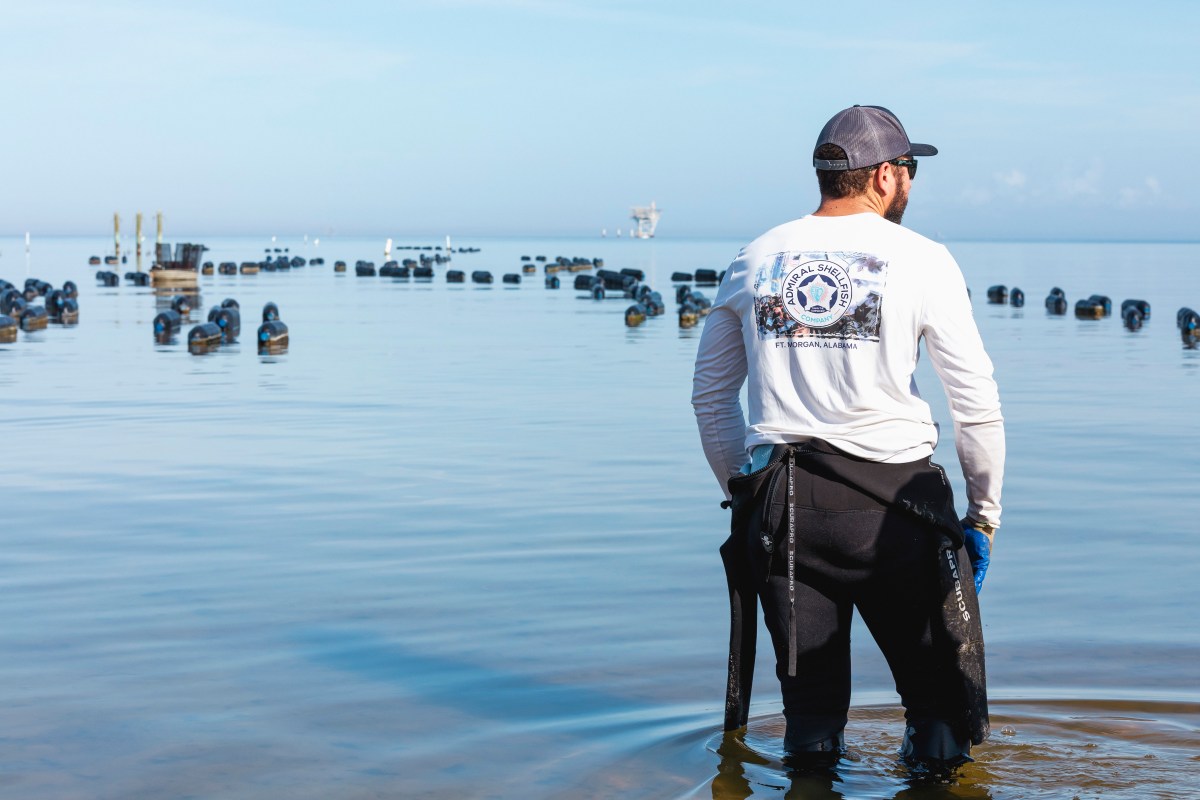
I visited the Admiral farm in early December. The morning had brought a low tide. Through the slash pines and saw palmetto at the farm’s approach, which sits just off Fort Morgan Road near the marina, you can already see it. The water is clear; so clear you feel as if you’re glimpsing the sandy bottom through a fish tank. 

Nearby, about 300 yards from Fort Morgan, the remnants of the Tecumseh, the Union warship that capsized after striking a mine during the Battle of Mobile Bay, is buried beneath the Bay. The farm works with the state to ensure the site remains undisturbed. Thus the name, Admiral Shellfish Company, replete with its “damn the torpedoes” ethos. 

This is Mobile Bay, I have known it my whole life, and while the water is typically less turbid during the winter months, this locale seems by contrast a different waterbody altogether from the caramel hues of the river-fed upper Bay. Here, the diurnal tide ushers in full-strength ocean water, and there is no siltation. On the hottest day of the year, the waters might reach 84 degrees, only slightly warmer than the near 80 degrees seen in Mali Ston. 

As a general rule, the perpetually brackish Mobile Bay averages 10 to 20 parts per thousand (PPT) for salinity. Because of the diurnal tide, however, the coveted 20 to 24 PPT salinity level is a near constant at the farm. On the day of my visit the salinity level is at 23. Scarce rain in October and November meant the farm never went below 25 in those months. 

So here, at the southern end of the Bay where the Gulf currents, underwater terrain, and surrounding geography converge in a swirl of exceptionally clear, highly saline waters, the ideal conditions exist for growing world-class oysters. In waters saturated with just the right concentration of minerals, nutrients, and phytoplankton, amid these conditions there exists some of the best that can be found, anywhere on earth. 

***** 

Approaching the farm’s shore you are greeted by Joe Ingraham, a bearded oysterman and great storyteller. He looks like “a pirate, 200 years too late,” as Jimmy Buffett might put it. The farm stretches out into the bay for 1,400 feet, and you can see black buoys rectangling in the sea. There are nearly 700,000 oysters growing in this space. It’s shallow and the Admiral team rarely has to use boats. It’s mostly waders when they’re out checking the cages. 

Ingraham is on the farm every weekday. When you visit Admiral, and observe Joe and co-owner Anthony Ricciardone working the farm, you quickly learn this is not a project for dilettantes. Or the faint-hearted. 

Ingraham is explaining the lay of the land to our photographer. 

“When the cage is suspended, that’s exactly where they sit – in that top two feet,” Ingraham says. “But that also gives them protection from would-be predators.” 

Ingraham and his team are constantly working with the oysters, shaking and handling and fine-tuning the bags. This is partly an effort to keep the “lip” off the shell, which is a form of curation that allows for better presentation. They also take the oysters out of the bag and let them air-dry, which helps kill off things like algae. 

“In terms of a handcrafted product, we’re literally shaping the cup of the oyster. Our chefs want consistency, and they want the same branded product every day,” says Ricciardone. “With these cups, it looks like the meat is exploding out of the shell, so it makes a really cool table presentation.” 

Ingraham pulls some oysters out of the water, shucks them, and shows us the contours of the cup. The point is clear. 

“The fact that Admiral is concentrating that much on each cup of oyster, that is what puts their product above and beyond,” says Seth Temple, head chef at La Chat Noir, an acclaimed restaurant in New Orleans’ Warehouse District that serves Admiral oysters daily. “They’re bringing that saltier oyster that customers crave. The salinity levels are matching that of Prince Edward Island, which is extremely rare in the Gulf.” 

But along Prince Edward Island, it can take three to four years to grow an oyster to market. At Admiral, they can grow an oyster to market in as little as six months, due largely to the warmth of the water, and other factors. In terms of putting Mobile Bay oysters on the global culinary map, this is an enormous advantage.

Read the rest of the article here.

Causeway Chronicles: Tales From A Storied Parkway

Finnell Forrest has been fishing off the Causeway in the Mobile-Tensaw Delta for nearly a decade. His dad, who gave up fishing years ago, started taking him here when he was a kid.

At this little spot on the Blakeley River, not much more than spitting distance from the Causeway, Forrest and his buddy David Stallworth angle for largemouth bass, brim, crappie, redfish, and speckled trout. But no black drum — they let that go. “Too many worms in them,” he says.

Finnell likes fishing in the spring and fall best. He watches the tidal calendar and prefers fishing this locale to a falling tide. “The Blakeley is a pretty spot,” he says. “I get in my boat sometime and go up the river a bit. It’s a 17-foot-center console called a Bayhawk. It’s my first boat.”

On most days, Finnell uses a spinning rod with a J-hook and cork, with about three to four feet between bobber and hook. “[These freshwater fish] don’t eat down, they eat up,” he says. “They’re an ambush fish so they have to look up at their prey and eat them.” Today he and David are fishing with shiners and live shrimp they picked up at the bait shop just down the road, “Hooked By The Bay,” the last of its kind on the Causeway.

After a day on the water, Finnell cleans his haul at home and fries them up, using a mixture of cornmeal and wheat flour, and that seems to work pretty well, he says. Pan-fried mostly. Sometimes a deep fry. Baked occasionally. 

Asked what he likes most about fishing the Delta, he says it’s “the relaxation, the wildlife. It’s peace of mind.” 

But even among the scenic splendor, threats loom. From the patio of the Bluegill Restaurant, where I find myself later — just a hop, skip and a jump from Finnell’s fishing spot — you cannot see the candy-striped smokestacks of Plant Barry rising twenty miles away in north Mobile County, at the site of Alabama Power’s 600-acre coal-ash pond. The back-end of the restaurant, which sits on the eastern portion of The Causeway in Spanish Fort, looks out over Pass Picada channel — a veritable honey-hole for redfish, speckled trout, and largemouth bass— before flowing into Chacaloochee Bay. Families stand along the rickety dock after dining and kids angle for privileged glimpses of alligators loitering idly for scraps.

Standing along the Pass in the magic hour, among the cattails and cordgrass, hyacinth and lotus blooms, it’s easy to forget the elephant that looms northward in the Delta. Before the 2008 coal-ash spill in Kingston, Tenn. — a spill that resulted in nearly $3 billion in damages, and the deaths of cleanup workers — the issue of coal ash was not part of the public imagination.

Over the past seven years, due to the work of Mobile Baykeeper and others, coal ash is now very much on the minds of coastal Alabamians. And there are other threats you’d soon as well forget, as you soak up the Amazonian wonder: things like the BP oil spill, the dangers posed by dredging, and the increased stormwater runoff brought on by rapid development. 

In the lower reaches of the Delta, where it traverses the Causeway and flows into Mobile Bay, there are no fish consumption advisories issued by the Alabama Public Health Department. But northward along the Mobile River, at the Cold Creek location, the state advises that no species of fish be consumed due to mercury contamination.

At David Lake, also on the Mobile River, advisories are issued for largemouth bass and black crappie. It’s worth noting that if a location or species does not have an advisory, it means there is not enough data on that site, not that it is automatically safe to consume fish from there. So it stands to reason that a largemouth bass, or black crappie, or any freshwater fish coming from up river and traveling to the lower Delta, is likely at risk for contamination. For subsistence fisherman who rely on those fish to feed their families, that’s not good news. 

Read more at Mobile Baykeeper.

Breaking The Habit: Mobile’s Kiss-Off To Single-Use Plastic

Old habits die hard in America. And one habit that has been especially difficult for Americans to kick is our wide-ranging and unrelenting addiction to single-use consumer plastic.

What makes plastic so insidious, and quite frankly so disturbing as a pollutant, is its omnipresence and longevity in our environment. It’s in the land, it’s in the air, it’s in the water, and now, it’s in our bloodstream, in the form of micro-plastics (which are generally considered to be any form of plastic less than five millimeters in length). And it’s not going anywhere anytime soon. (It is said that a plastic grocery bag will remain in the environment for up to 500 years.)

While plastic’s long-term effects on human health are still the subject of inquiry and debate, according to the Plastic Health Coalition, a research and advocacy alliance, we do know that micro-plastics disrupt endocrine function in humans, not unlike PFAs and other toxic chemicals. And it’s not just humans that fall prey to its poison. It’s been forecasted that by midcentury there will be more plastic by weight in our oceans than fish, a fact that augurs grave consequences for our fisheries and marine life. If that’s not enough, recent reports reveal the skies are now raining micro-plastics at a level much greater than previously thought. That fact alone should be enough to make the multitudes weep. Read more.

It’s All Connected: A Q&A With USA’s John Lehrter

“We’ve been very blessed in Alabama. We’ve traditionally had low population density in the watershed. One of the reasons I love living here is just being able to get up in the Delta. Ten minutes from here and I can be in this vast wilderness that is not only aesthetically beautiful but also providing all of these essential life-support services for humankind and I think we take that for granted. But it’s not a guarantee that it’s going to be there in the future. So I think the average citizen just needs to be aware that we’re all connected to this, and that there are limits to growth and how much humans can exploit our resources.”

Read the interview on Mobile Baykeeper.

Warmest Climes

Here at Mobile Baykeeper, we talk about our responsibility to future generations. How it is our duty to protect the bounty of the Mobile Bay Watershed for our children and grandchildren, so that it may sustain them in the same way it has sustained us in our lifetimes. This is what drives much of our work.

What we don’t talk about as much is our responsibility to the past — to the history, ideal, and natural perfection of what came before. When the first Spaniards showed up on the Gulf Coast in the early 16th century, this stretch of land must have been something to behold. It was an exotic clime (the French eventually called it a “trembling land”) that no doubt elicited a WTF moment, and settling here, in the case of the French a century later, was no picnic. Just ask the Cassette Girls of Fort Louis, who arrived in 1704 fresh off the boat from Paris. They arrived at Twenty-Seven Mile Bluff, the French equivalent of Jamestown, and found themselves living in a Hank Williams Jr. song (“Country Boy Can Survive”), likely skinning bucks and running trot-lines.

As local naturalist and author Ben Raines points out, Alabama remained untouched by the glaciers of the last Ice Age, a fact that accounts for our wealth of biodiversity and the darkly romantic aesthetic of our delta, one of the country’s last great wildernesses. Our patron saint of the sciences, E.O. Wilson, famously dubbed it “America’s Amazon.”

“Warmest climes but nurse the cruelest fangs,” Herman Melville once wrote. Today’s cruel fangs are not the smallpox and yellow fever that ravaged the colonists and natives of old, but — aside from hurricanes and floods — come in the form of pollution, notably the Plant Barry coal-ash pond that corrupts our groundwater and puts our region at such great risk.

Of course, there are other pollution culprits: excess nitrogen from runoff, PFAs, PCBs, etc. And they’ve all left their mark. 

“All these people that are moving here, they ain’t got any idea what a paradise we used to have,” Jimbo Meador, our local version of Huckleberry Finn, told Mobile Baykeeper last year. “They have no conception of what Mobile Bay used to be like. And you know, it is a dying breed that remembers what it used to be like. And so, it’s hard to fathom for some people, but I used to spearfish in Mobile Bay. I mean it was that clear. I used to put on a mask and snorkel and fins and I used to chop barnacles off of the pilings and spear sheepshead and even flounder and stuff.”

You can never return to the past; it’s a fool’s errand to try. But it takes a herculean effort not to squander all the good stuff, and to keep the rock we’re pushing up the hill from rolling back down on us. And while much has been lost, a lot of good remains. We still have quite a treasure among us. Perhaps if we can stop the pollution our waters can begin to heal.

— Caine O’Rear, Communications Director, on behalf of the Baykeeper Team

Pass Picada

From the patio of the Bluegill Restaurant, you cannot see the candy-striped smokestacks of Plant Barry rising twenty miles away in north Mobile County, at the site of Alabama Power’s 600-acre coal-ash pond. The back-end of the restaurant, which sits on the eastern portion of The Causeway in Spanish Fort, looks out over Pass Picada channel — a veritable honey-hole for redfish, speckled trout, and largemouth bass— before flowing into Chacaloochee Bay. Families stand along the rickety dock after dining and kids angle for privileged glimpses of alligators loitering idly for scraps. Elvis likely stood here during one of several Bluegill experiences in the ’50s, perhaps after the time he performed at a Vigor High School assembly, only to have the show cut short due to the saltiness of his below-the-belt gyrations.  

Standing along the Pass in the magic hour, among the cattails and cordgrass, hyacinth and lotus blooms, it’s easy to forget the threat that looms northward in the Delta. Before the 2008 coal-ash spill in Kingston, Tenn. — a spill that resulted in nearly $3 billion in damages and cleanup costs — the issue of coal ash was not part of the public imagination. Over the past seven years, due to the work of Mobile Baykeeper and others, coal ash is now very much on the minds of coastal Alabamians.

If you’re not privy to the news, you can learn why Mobile Baykeeper and the Southern Environmental Law Center filed a Notice Of Intent To Sue Alabama Power for its plans to leave more than 21 million tons of coal ash buried along the Mobile River, a historic body of water that was designated by American Rivers as the “third most endangered river” in the U.S. in 2022. Litigation has always been a means of last resort for Mobile Baykeeper, and these recent events are no exception. 

In this time of global upheaval and cataclysm (both actual and imagined), when all seems so transient and short-lived, we have the chance to ensure a vital corner of our world, and one of national significance no less, is preserved and protected just as it should be. As always, we can’t do it without your support.

Mobile Baykeeper Talks to Ben Raines about his new book, “Saving America’s Amazon”

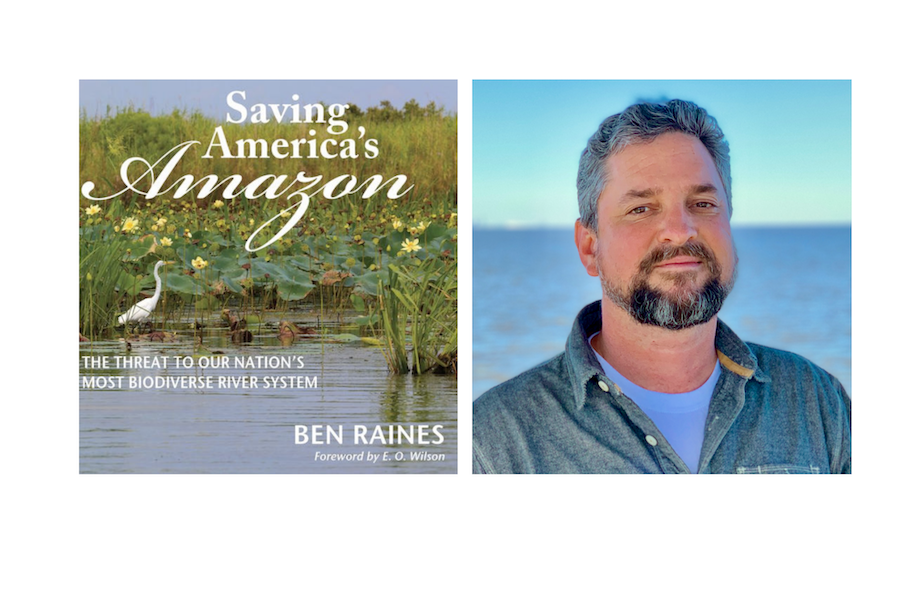
A writer, naturalist, and filmmaker, Ben Raines has been reporting on environmental affairs in Alabama for most of this century. As a former journalist for the Press-Register, he served as our region’s foremost environmental watchdog. Since leaving the paper, he has worked in film, authored books and scientific papers, and served as the executive director of the Weeks Bay Foundation, an environmental non-profit. His 2017 documentary about an ancient underwater cypress forest in the Gulf of Mexico, The Underwater Forest, was broadcast on public television, and other footage he’s shot has appeared on the Discovery Channel and National Geographic TV. In 2018, Raines made history when he discovered the remnants of the Clotilda, the last American slave ship, at the bottom of the Mobile River near Twelve Mile Island.

On December 12, Raines will release his latest offering to the world, Saving America’s Amazon, via New South Books. The book, which includes a foreword by eminent biologist and Mobile native E.O. Wilson, examines the rich biodiversity of the Mobile River Basin (a.k.a. “America’s Amazon”) and the environmental threats it faces as a result of pollution, increased development, and unscrupulous decisions by industry and elected officials. Yet despite a poor environmental record, Alabama still boasts more species per square mile than any other state.

Read my discussion with Raines over at Mobile Baykeeper.