Baez

From American Songwriter interview, 2013.

Joan Baez epitomizes the ideal of the American folk singer. Ever since rising to national prominence in the early ‘60s, she’s stood at the crossroads of music and social protest, adhering firmly to the belief that music can in fact change the world.

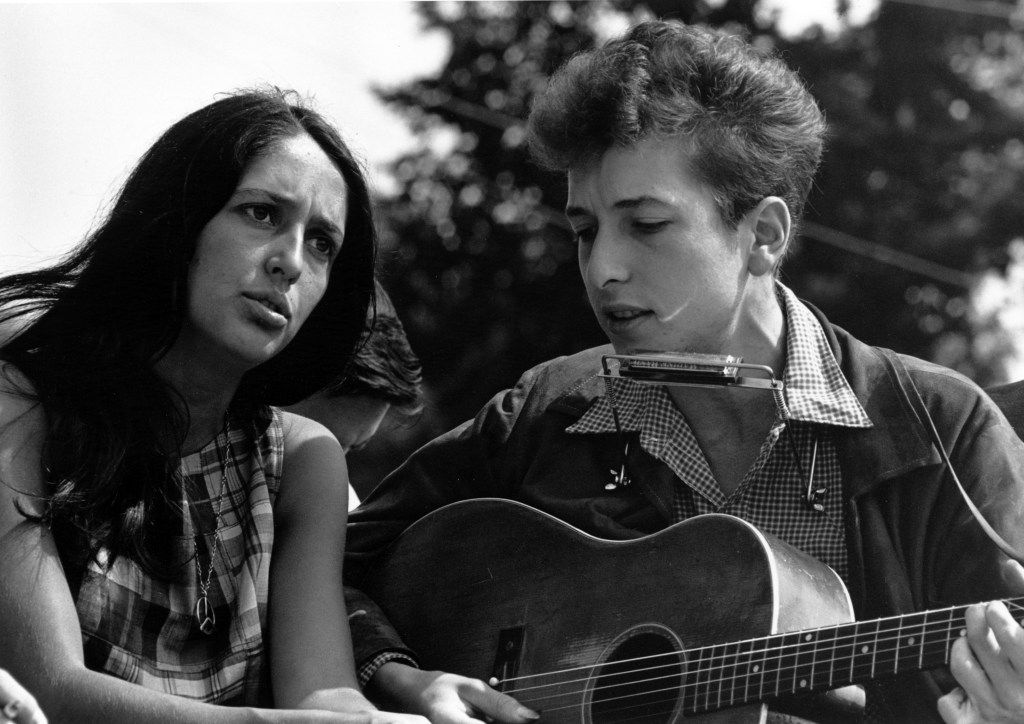
Baez cut her teeth as a singer in the Cambridge, Massachusetts folk scene of the late ‘50s, when she was enrolled in college at the Boston University School Of Drama. She was signed to Vanguard Records in 1960, and soon became an international sensation. Early in her career, she met Bob Dylan, who at the time was hailed as the second coming of Woody Guthrie. Baez helped introduce the young Dylan to the world at large, sharing the stage with him and recording his songs.

Throughout her career, Baez has primarily been known as an interpreter of other people’s work. However, many of her own compositions, such as “Diamonds And Rust” and “Here’s To You,” reveal her depth as a lyricist and songwriter.

Baez continues to record and tour – and she looks and sounds great. Her last album, Day After Tomorrow, was produced by Steve Earle, and features songs by Elvis Costello, Gillian Welch, Tom Waits and others.

Do you remember the process of writing that song? Was that one that came in a burst or did you cultivate it for a while?

As this story is being written, Baez is set to embark upon a tour of France, followed by another tour with Kris Kristofferson, whom she first met at the Isle of Wight festival years ago. We spoke with the singer about Dylan, songwriting, and the state of American politics.

You’re known primarily for the songs you cover. Was there ever a point when you considered writing more of your material?

I haven’t written for the last 20 years. I think the poetry in my songs is really good. And I think the melodies are really good. And I think the only trick with my songs is that they’re not the kind of songs that people are urged to cover because they’re more personal. I write them more personal; it’s like reading a poetry book.

“Diamonds And Rust,” which is one of your more well-known compositions, fits more into that personal category.

Yeah, and it’s the only one that crossed over from very personal to being acknowledged in a very big way.

Well, it’s funny because I was writing it and it had nothing to do with what it turned out to be [Ed note: It’s widely believed to be about Bob Dylan]. I don’t remember what it is, but I think I was writing a song. It was literally interrupted by a phone call, and it just took another curve and it came out to be what it was.

Your history with Bob Dylan is a significant part of your legacy as an artist, which I imagine has been a double-edged sword for you. Was there ever a point where you considered not covering Dylan songs in concert?

His songs are so amazing. Even through his dormant period, for me, his songs can stand on their own. They’re the best.

When you play the Dylan songs live, does your relationship to them feel more aesthetic than personal?

Well, yeah. I haven’t seen him at a lot of them [my concerts], but he was very sweet in my documentary. So, I think the playing field’s level, and the songs are what they are.

Ain’t No Grave

There is a train that’s heading straight
To Heaven’s gate, to Heaven’s gate
And on the way, child and man
And woman wait, watch and wait
For Redemption Day

When Sheryl Crow, the subject of this issue’s cover, penned these lines in 1995 in response to her experiences on a USO trip to war-torn Bosnia, most Americans would not have imagined that, nearly 25 years later, they would resonate here at home as precisely as they do. The words are from “Redemption Day,” off Crow’s eponymous second album, which she has now reworked for her latest effort, Threads. On Threads, the song functions as the spiritual lever of the record, offering its prescience to the present with a power and clarity that is intensified with the vocal accompaniment of an American icon, Johnny Cash.  Fans will remember that Cash recorded it shortly before his death in 2003, seven years before its posthumous release on Ain’t No Grave: American Recordings VI. This new version features vocals from both artists and the video weaves their images with scenes of human bravery and tragedy with such force that John Carter Cash, Johnny’s son, found it overwhelming.

Threads is a long-gestating effort from the Missouri native that boasts mostly new music, with a few well-placed covers and features collaborations with heavyweights such as Mavis Staples, Keith Richards, Chuck D and Stevie Nicks, as well as younger singer-songwriters Jason Isbell, Chris Stapleton, Margo Price, St. Vincent, and Gary Clark Jr. to name a few. It has been well worth the wait.

****

Our greatest artists have always chronicled the times, and the best among them today are documenting the present with their music.  And still, they are doing it with defiant hope. Merely days after the shootings in Dayton and El Paso, Lana Del Rey posted to Instagram an excerpt from a song she’d written not long after the news of the carnage broke. The tune is called “Looking For America,” and it reads in part: “I’m still looking for my own version of America/ One without the gun, where the flag can freely fly/ No bombs in the sky/ Only fireworks when you and I collide/ It’s just a dream I had in mind.” Let’s hope it finds its way on to Del Rey’s soon-to-be released album, Norman Fucking Rockwell!  

Elsewhere in this issue, we profile the Lumineers, whose new album, III, grapples with the plague of addiction. (In 2017,  there were 94.4 opioid prescriptions for every 100 persons in Tennessee alone.) One of the band’s principals, Jeremiah Fraites, lost his brother to heroin addiction when he was 13, long before the opioid crisis hit. The album charts the trials of a fictional family but, for Fraites, the writing process was cathartic. “I’d be lying if I didn’t believe maybe some people are going to feel this album is too heavy,” he says, “but I think it’s a very raw, very honest album.”

We also talk to Brittany Howard, the vocal powerhouse for Alabama Shakes, who is about to release her first solo album called Jaime. The record is a tribute to her late sister, who passed away when Brittany was a young teenager, but it also explores in remarkably nuanced fashion issues of race, identity, and religion. Howard is bi-racial and has had romantic relationships with men and women, thus giving her a multiplicity of perspective. One song chronicles a family episode in her childhood when someone put a bloody goat head in her father’s truck, an event that her family believed to be racially motivated. Another song makes the case for unconditional divine love and acceptance, the kind that exists outside the dictates of organized religion.

Sadly, as this issue heads to the print, we say goodbye to David Berman, whom we featured in the last issue for his new project, Purple Mountains. Berman is best known for his work with Silver Jews, and though he is not a household name, his songwriting, along with his published poetry, commands a deep and abiding respect among fans, fellow artists and critics. Berman, who passed away on August 7 at age 52, was open about his struggles with depression and substance abuse. Throughout his life he suffered profoundly, but in the midst of that suffering he managed to carve out a body of work that is redolent with truth and beauty, humor and sadness. It is a body of work that will stand the test of time. We are left with the memory of his life, along with his sublime words and music.

I believe the stars are the headlights of angels
Driving from heaven to save us
To save us
Look in the sky
They’re driving from heaven into our eyes
And though final words are so hard to devise
I promise that I’ll always remember your pretty eyes
Your pretty eyes

— from the song “Pretty Eyes” (1996)

Tip Of The Iceberg

From May/June 2019 Editor’s Note of American Songwriter.

“When I listen to other songwriters, I’ve never found anything more powerful than when you don’t have to use every little word in the English language. It has to be sparse.”

That’s Justin Townes Earle, the subject of this issue’s cover story, talking to American Songwriter back in 2014, shortly before the release of the album Single Mothers. Later this month, Earle returns to the mix with his eighth full-length studio effort The Saint Of Lost Causes, which is being released on New West Records. For this collection, the 37-year-old Nashville native continues to employ considerable economy in his lyrical approach. Thematically, the album finds Earle working with big-picture, topical subject matter, turning his eye on America’s social challenges à la one of his songwriting heroes, Woody Guthrie. 

This pivot toward the macro marks something of a shift for Earle, whose subject matter has typically favored a more first-person, autobiographical approach. Yet Earle insists the new album is “social” and not “political” in nature. The songs address complicated subjects that are beyond any one person’s power to affect, but have an impact upon all of us individuallyissues of gentrification, the opioid epidemic, among others, but make no mistake, nothing in this work drifts toward coffeehouse folk. Like many of the works in his catalog, these songs are dressed up in various elements of southern roots music: boogie-woogie blues, noirish country, Memphis rock and roll.

One of the album’s more affecting numbers, “Over Alameda,” comes about halfway through the album. It’s a ballad set in South Central Los Angeles that tells a story of generational poverty, de facto segregation, and deindustrialization that culminates with a subtle suggestion of the causes of gang life. A country folk-sounding number with ghostly pedal steel, the lyrics are sparse, and decades of American history and economics are detailed with a handful of simple verses about a family.

Mama would tell me of her hopes
What she hoped to leave behind
What she thought she would find out in California
She’d talk about Mississippi
Still don’t know how it is
Any place can be worse than this
It’s hard to believe

The song takes its place in the long line of “going-to-California” folk songs. The song’s speaker is a 19-year-old boy living in the Jordan Downs Housing Project in the Watts neighborhood of Los Angeles. We understand that his mother had moved from the Mississippi Delta to Los Angeles in the mid-’60s and his parents bought a home after his father landed a job at the Firestone factory in south Los Angeles. But the story takes a turn when the factory closes down, and that Promised Land remains ever elusive, even in the California of our collective imagination.

Then the jobs moved out
Then daddy died and we lost the house
Moved into the Jordan Downs
And been here ever since

Once they’ve settled in Jordan Downs, the mother dreams of life “Over Alameda,” the street that borders the housing project to the east, beyond which “the green grass grows” and the “white folks live.” But the young protagonist has only known life in Jordan Downs, and he says “all I have discovered/ There is nothing for a boy of color but to fight.” Jordan Downs was ground zero for the Grape Street Watts Crips, a notorious gang that was the subject of the early ’90s film Menace II Society, and while the narrator does not explicitly say he is a Crip, all he knows is that very neighborhood and the reality of an endless fight to escape to something better, “over Alameda.” The listener can fill in the gaps how they see fit.

Ernest Hemingway explained the importance of omission in writing in his treatise on bullfighting, Death In The Afternoon, arguing that he attempted to show only the tip of the iceberg in his work. “If a writer of prose knows enough of what he is writing about,” Hemingway said, “he may omit things that he knows and the reader, if the writer is writing truly enough, will have a feeling of those things as strongly as though the writer had stated them. The dignity of movement of an iceberg is due to only one-eighth of it being above water.”

In the same spirit, Earle does not spell out the historical and geographical minutiae of the story. Such details are not necessary for one to fully apprehend the overtures of meaning offered by the song. “Over Alameda” is really just a song about the hope for something better, and it allows the emotion of the music to convey that hope as much as anything else. The listener must rely on their own creative capacity to fill in the details of the story, which in turn helps deepen their connection to the song. As a result, instead of creating distance between the listener and his work through his economy, Earle is closing it.  

Hemingway’s iceberg analogy is indeed an interesting theory of writing, certainly not the only one, but one Justin Townes Earle seems to have used remarkably well.

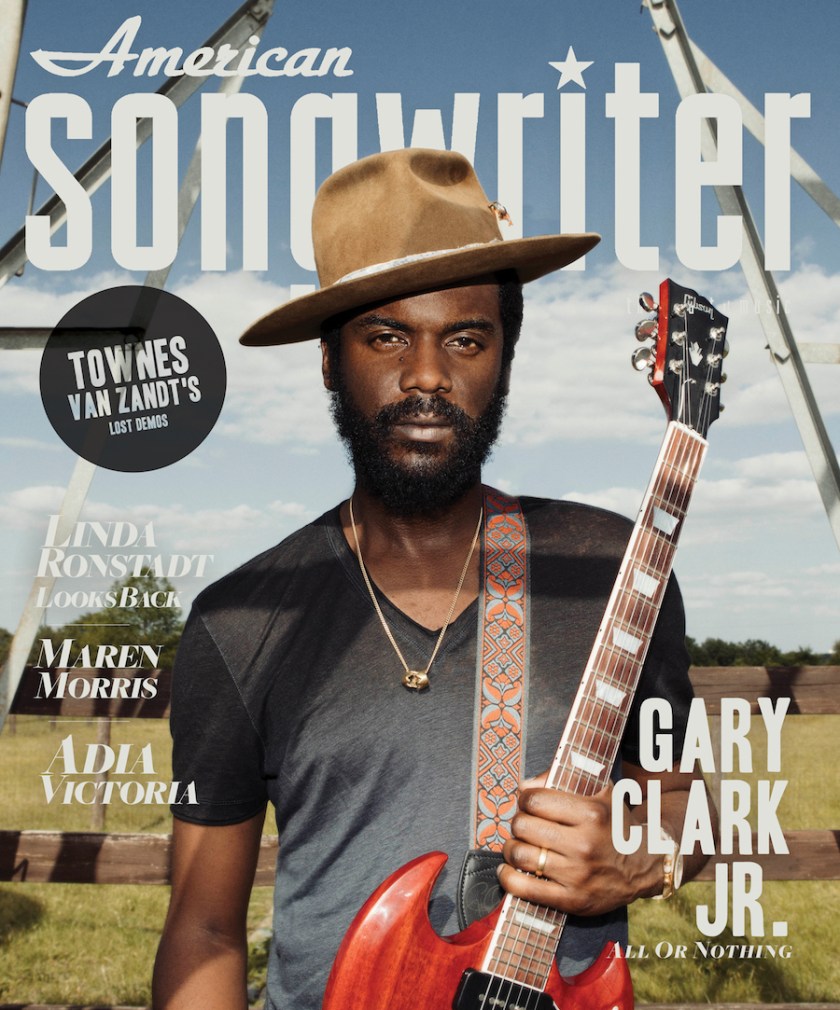
Gary Clark Jr.

Cover story for March/April 2019 edition of American Songwriter. 

Let It Be

 Gary Clark Jr. was ready to take a stand.

When the Texas artist entered Arlyn Studios in downtown Austin to begin making This Land at the beginning of 2018, he wanted to get some things off his chest. Since the release of his last album in 2015, The Story of Sonny Boy Slim, Clark had, like the rest of us, been a witness to the greatest political and sociological shockwave to hit the United States since the Long Hot Summer of 1967. The Black Lives Matter movement, which first took root in 2014, had reached a crescendo after a raft of highly publicized killings of black Americans at the hands of police. From that followed the protests of NFL quarterback Colin Kaepernick and other players, who, as a show of solidarity with the movement, opted to kneel during the playing of the National Anthem. And then there were the events in Charlottesville, the picturesque college town that ended up playing host to a white supremacist rally that resulted in the vehicular homicide of one protester and the injury of 40 others. There had been more, and set parenthetically within the election of Donald Trump, it was clear something had changed in the ether of the republic.

There had been changes in Clark’s personal life too, mostly for the better. In 2016 Clark married his Australian model girlfriend Nicole Trunfio and the two are now parents to Zion, who is four, and one-year-old Gia. The couple also bought a 50-acre ranch just outside Clark’s hometown of Austin. Life was good, but the artist felt a growing angst within.

The swirling currents of the past three years had cut into Clark’s personal experience and created a need for an outlet of expression. According to producer and engineer Jacob Sciba, who’d also worked on the Sonny Boy record, it was this sense of urgency that informed much of the recording process. Clark was also determined to elevate the level of his songwriting, and this time around he wanted to have a message, to use his voice for the greater good. In short, he wanted to say something. “No more ‘Mr. Nice Guy,’” he told Sciba, “he’s dead.”

*****

I first meet up with Clark backstage before a show in Chattanooga, in late 2018. The album’s first single and title track, “This Land,” has not been released. When the video for the song drops in January, it makes a considerable splash. Directed by British-born filmmaker Savanah Leaf, the video is conceived as short film that features several black children in the Texas countryside, situated among Confederate flags and other emblems of the Old South. Clark’s character is holed up in a white-columned mansion throughout, “right in the middle of Trump country,” shredding on a Gibson SG next to a raised American flag.

Sciba knew it couldn’t be radio-edited and because of the raw power of the song he felt a twinge of concern for his friend of 10 years, knowing Clark was opening himself up to attack. Indeed, the video sparked a backlash from a portion of Clark’s audience via social media, who accused him of playing the “race card” and cashing in on the hot-button issues of the day.

Clark responded days later on Twitter in very clear terms: “People want to escape through music to be entertained and take their mind off of reality. I’m not an entertainer. I want to be in the middle of it and face reality in my life and be honest about my feelings.” What he did not say on Twitter, but did reveal to Rolling Stone after the video’s release, was that the song’s lyrics stemmed from an incident he’d had with a neighbor at the ranch. According to Clark, the neighbor had approached him and said, “Who owns this house?”, refusing to believe it could belong to someone who looked like Clark. All of which happened in the presence of Clark’s young son, who was left shaken and confused by the incident. Clark kept his cool in the moment, but tough questions followed. What had been swirling in the ether was now on the ground. A short while later Clark’s venom found its way into “This Land” when he wrote:

I remember when you used to tell me
‘Nigga run, nigga run
Go back where you come from
Nigga run, nigga run
Go back where you come from
We don’t want, we don’t want your kind
We think you’s a dumb bum’
Fuck you, I’m America son
This is where I come from

This land is mine.

My first question for Clark on the night we meet is about the song. Clark, who stands a wiry 6 feet 5 inches, is soft-spoken and demure, and there is a real gentleness about him. He takes some time before answering.

“I just got on the microphone and just let it out, you know?,” he says. “It’s hard to explain these songs. I spent my whole life being black in Texas and [there’s] blatant and subtle and abrasive discrimination. With the current climate politically, it’s like, ‘What the fuck is happening?’ Everyone just wants to be treated like a human being. We all have family and people that we love and care about, and we’re trying to take care of them and support them like everybody else and we’re here. We’re here. We’ve all migrated from somewhere in this land and we’re here … You can spend your whole life being pissed off at somebody that you don’t understand, but at the end of the day, you’re going to be buried right next to them. So what are you going to do?”

Sciba knew the song was a game-changer as soon as Clark shared the words. “I heard the song as a beat for seven months, and then one day all of the sudden I heard a lyric, and Gary was like, ‘I think I have something.’”

“It’s scary in a sense because Gary is such a calm and peaceful guy,” Sciba explains, speaking by phone one night after a studio session at Arlyn. “He’s very sweet and soulful and this is very aggressive … but I knew it was something that was going to get people’s attention. So let it be. If it offends, it offends.”

“This Land” subtly samples Sharon Jones and the Dap Kings’ R&B version of “This Land Is Your Land,” recorded by the group in 2005. Woody Guthrie wrote the original lyrics in New York City in 1940, inspired by a recent cross-country road trip he’d taken. He also wrote it as a response to Irving Berlin’s jingoistic “God Bless America,” which was dominating the airwaves at the time. The original lines include the more socialist-leaning verse that questions the notion of private property, a section largely omitted from schoolbooks.

For much of her professional life, Woody Guthrie’s daughter Nora has worked on behalf of her father’s legacy, as the former director of the Woody Guthrie Archives in New York City and through projects like the Billy Bragg and Wilco Mermaid Avenue albums. She says it’s been fascinating to watch how “This Land Is Your Land” has figured into American battles for social, economic and political justice through the decades.

“Sometimes the song is like a hymn or prayer. Sometimes it’s like an anthem. And sometimes it’s like a battle cry,” she says. “But no matter what the tone, taking a line from Woody’s ‘The Ballad of Tom Joad,’ the song belongs to ‘wherever people are fighting for their rights, that’s where I’m gonna be.’ So this is how, and where, Gary Clark Jr. is taking the fight now, with genuine passion and grit.”

Like so many Americans, Clark learned “This Land Is Your Land” as a kid at school.

“It’s one of the first songs we learn and we sing it together – it’s like the Pledge of Allegiance,” he says. “And when you’re kids, everybody’s together. You don’t see differences until you get older, and older people influence you to think about other people a certain way. I just want to get back to singing that song like we were kids again, you know? It’s fucked up when people don’t want to. There’s a huge debate over the NFL and people taking a knee. It’s lost what it’s supposed to be because people got so offended and hurt by it personally that they don’t want to understand what the message is. It’s like, ‘We want to be seen. We want to be respected.’ It’s been too long, it’s been too long. Our heroes and the people that we look up to, they either get murdered or exiled for trying to speak up and do the right thing for our people.”

 Early Days

 Gary Clark Jr. was born in the Oak Hill section of Austin, Texas in February of 1984. He was the second of four children and the only boy. His dad, Gary Clark Sr., sold cars for a living and his mother, Sandy, worked as an accountant. They were Baptists. It was a decidedly middle class existence.

Clark’s parents weren’t professional musicians but they embraced music: his mother’s Curtis Mayfield and Jackson 5 records were on the turntable, while Clark’s dad preferred B.B. King and the funkier stylings of Johnny “Guitar” Watson. He likely inherited the performance bug from his mom, who taught him to moonwalk as a child. When Clark was three, his parents surprised the family and took the kids to see Michael Jackson perform in Denver. Seeing Tito Jackson on stage with the guitar was a eureka moment for the young Clark. He never forgot it.

Seven or so years later, while in the fourth grade, Clark wrote his first song. It was called “Dream Girl” and he wrote it with his friend Ryan. It was about a girl named Courtney whom they both had a crush on. Clark had written the words down on yellow legal paper, which he carried in his pocket for what seemed like an eternity. When he and Ryan finally summoned the courage to sing it for her, she was unimpressed. Back to the drawing board, he thought to himself.

When he was in middle school in the mid-’90s, a classmate named Eve Monsees, whom he’d known since the third grade, got a guitar. She earned instant cool points at school and Gary wanted in on the action. That Christmas he asked his parents for a guitar, specifically requesting a “Mute Guitar,” a term he got from the setting on his dad’s Casio keyboard that made the notes sound funky. He got an Ibanez RX-20 electric. He’d been listening to his parents’ records at the time and the first song he attempted to play was “I Want You Back” by The Jackson 5, later trying his hand at other soul hits. (“Kind of one-note type of stuff,” he says.) He hit the school library when Christmas break ended and checked out a few books on guitar instruction, getting a handle on the basic chords. Then he started buying Guitar World magazine at the grocery store and began to hear the licks in songs, noticing little things from the instrument he hadn’t before. “I just ran with it,” he says.

To this day, Clark has never taken a formal lesson. In those early days Monsees was always a step ahead. At the time she was in an all-girl band that played mostly Ramones songs. She and Gary competed against each other in the 7th-grade talent show and then joined forces the next year, performing Stevie Ray Vaughan’s “Pride And Joy” and taking top prize. Clark has credited Monsees, who today performs regularly in Austin with her band Eve and the Exiles, as being his early mentor. He even gave her a shout-out when he accepted his Grammy in 2014 for “Best Traditional R&B Performance” for the song “Please Come Home.”

“I feel like he gives me more credit than he should sometimes,” says Monsees, whose day gig involves running Antone’s Record Shop in Austin. “He was someone who had a great ear and a natural ability to pick up on things.”

Sometime in 1998 Eve and Gary found their way to Babe’s, a now-defunct sports bar on Sixth Street that hosted a weekly blues jam on Sunday nights. For a middle-schooler, Eve was preternaturally hip to the music scene, Clark says, and the outing was her idea. That night on stage she performed “Pride And Joy,” along with “T-Bone Shuffle” by Texas blues great T-Bone Walker.

Before long, the duo began hanging regularly at the smoke-filled club and jamming with everyone from high-schoolers to grizzled pickers in their 70s. When they hopped on stage for a song or two a guitarist might call out, “Hey, we’re going to play Freddie King’s ‘Hide Away.’ Do you know it? Don’t worry, we’re just going to cue A. Just watch me,” Clark relates. So they’d just comp the A, soaking it all in.

Some of the musicians burned them CDs. Stuff from Lightnin’ Hopkins, Albert Collins, Magic Sam, old B.B. King recordings. “It just went on and on,” Clark says. “Every time we’d show up, we would learn about someone new … They would give us the chance to be up there and have that experience on stage while teaching us.”

It wasn’t long before Gary and Eve caught the ear of Clifford Antone, the late owner of Austin’s storied blues club Antone’s. He invited Eve and Gary to perform at one of the club’s blues jams. Soon they’d be playing regular gigs in various dives along Sixth Street, even on school nights, with X’s on their hands to denote “underage” status.

By this time, Clark was living and breathing the blues. “It took over everything,” he says. “I mean, I don’t really have any memories. Everything kind of faded away. It was just music. It was just the blues. It was like [Eve and I] had our own secret as young kids … it was music that wasn’t popular on the radio that all the other kids were listening to … it was like, ‘Holy cow, treasure over here.’”

Around the time school took a backseat, as did basketball, with Clark quitting the JV team so he could focus on guitar, a fellow student once told him, to his puzzlement, “Black folks don’t play the blues.” But Clark had found his musical home. He’d end up scrambling to finish his homework five minutes before class because he’d blown it off the night before. “I’d spent that time trying to figure out how to solo to Albert Collins’ ‘If Trouble Was Money.’ It was that, all day, all night.”

Clark was also writing — a lot. He had a big volume of Langston Hughes poems that he’d lug around and mine for inspiration. When he was supposed to be taking notes in class he was drawing in his notebook or writing poems and stream-of-consciousness passages. “My mom was going through that stuff a little while ago,” he says, “and she said, ‘I don’t know how you got out of school, all the stuff you wrote has nothing to do with school.’”

10,000 Songs

One night before a show several years ago, Clark was hanging with Sean McCarthy, a fellow Austinite and music biz vet who works with Jimmie Vaughan. They’d known each other for some time and McCarthy mentioned he wanted to share some tunes. Clark was expecting just a handful. Instead, McCarthy ended up giving him an entire hard drive of more than 10,000 songs, a lot of it stuff the artist hadn’t heard before.

By this time Clark had set up a home-rig with his laptop, turntables and beloved Akai MPC X drum machine, his main editing tool. It wasn’t long before he was chopping up songs from the hard drive and making beats, thinking at the time no one would hear them. “Then I thought, ‘Maybe, eventually, I’d start throwing them around and see if rappers or singers wanted to get on them,” he says. “But then I was like, ‘No, this is kind of good. I’ll keep this for me.’”

Most of the songs that appear on This Land grew out of the patterns Clark created on the MPC X. Since completing the Sonny Boy Slim album and setting up the home-rig, Clark had been constantly making music, programming beats, almost like a man possessed, Sciba says. And though it might seem surprising that a musician so renowned for his guitar prowess would find that much creative inspiration in a drum machine, to Sciba, it makes perfect sense.

“Those beats are still his musical patterns and heartbeat and I think that’s what makes him special,” Sciba says. “But he doesn’t program in a classic hip-hop style, he programs like a blues kid who uses different color palettes. He still has the musical knowledge of a melodic guitar player even when he’s programming a drum sound. It’s not a Pro Tools cut and paste. And his pocket on a drum kit is about as nasty as it gets. He could be playing pencils on a desktop, and it’s going to be funky.” (Clark began playing acoustic drums off and on as a teenager.)

Like most musicians, Clark doesn’t think in terms of genres. He sees the thread in everything. It was during his teenage years, not long after he began playing guitar, that he became aware of the monofilament that runs from the blues all the way through hip-hop.

“Let me play something for you,” he tells me in Chattanooga, his eyes lighting up. He picks up his iPhone, notices a few texts from his wife, and then dials up 2Pac’s song “Krazy” from the rapper’s posthumously released 1996 Don Killuminati album.

The guitar comes in and Clark says when he first heard the song it reminded him of riffs he’d heard in the music of Stevie Ray Vaughan. “It’s the blues,” Clark says, smiling. “It makes sense to me. He’s a rapper, but he’s a storyteller. And it’s bluesy.” When you consider that Clark was soaking up the sounds of B.B. King alongside the works of 2Pac, Dr. Dre, and hip-hop producers like DJ Premier and J Dilla, it all becomes clear.

“With black music, I feel like it kind of took a turn somehow,” Clark continues, noting that he’s been called “musically schizophrenic” in the past. “[At some point], blues was kind of abandoned and started to get funkier and more rebellious, I’d say. Right around when Johnny ‘Guitar’ Watson dropped ‘Ain’t That A Bitch’ [in ’76], we kind of went that way, and I feel like other artists took the blues and made it this big, electrified rock thing. I guess instead of going that way, I was like, ‘Well, what I’m doing is just a continuation of the blues.’ I think Big K.R.I.T. is a hip-hop artist, but I feel like he’s the Muddy Waters [of the time].”

At 32, Big K.R.I.T. is just a few years younger than Clark and, like Muddy Waters, hails from Mississippi. When I mention K.R.I.T.’s song “The Vent,” a brooding, plaintive number that laments the passing of some of K.R.I.T.’s comrades, not to mention Kurt Cobain, Clark says, “I mean, I cried listening to that. It’s heavy and you feel it. You can feel it.”

As a fledgling artist, Clark had difficulty wrestling with his elastic musical tendencies, especially given that he was being hailed as the next great blues champion. Then one day at Stubb’s in Austin he had a chat with Atlanta R&B singer Cody Chesnutt. Clark told Chesnutt he’d written a batch of songs that weren’t traditional blues, but felt sheepish about releasing them to the world lest the blues police call him out for it. Chesnutt told Clark he’d be doing the world a disservice if he kept the music to himself.

“He told me, ‘That’s your soul and that’s what you do. You’re grabbing the message and translating it somehow.’ And I was like, ‘Okay, there are no rules.’”

********

With This Land Clark was determined to make a lasting piece of art. And he was willing to obsess over every last detail that went into it. In preparation, he immersed himself in some of the great pop albums of all time, classic offerings that had moved him in the past like Michael Jackson’s Thriller and Off The Wall, Nirvana’s Nevermind, as well as works by Neil Young, OutKast and Bruno Mars. “I was just revisiting what it was about these albums that made me feel a certain way,” he says.

Clark has said he often struggles with lyrics and often they are the last piece of the pie to emerge. He says he still writes in notebooks; sometimes, it’s just a song title he’ll jot down and come back to later. Other times he’ll make voice notes on his iPhone where he’s either singing, humming a melody, or beat-boxing. In the studio he’ll often hit record and just start singing into the mic, freestyling to his heart’s content and then try to build something from that. “I try to make it all make sense in my head, so it sticks that way,” he says. “But if I can’t sing it naturally, or it just doesn’t flow, then maybe it’s not the right pattern.”

*****

This Land stands as a virtual survey of black American music, a widescreen offering that connects the tissue between blues, hip-hop, reggae, Stax- and Motown-era soul, Prince, the Jackson 5, and more. Some of the material sampled came directly from McCarthy’s hard drive, including music from Guyana reggae artist Johnny Braff, R&B/jazz sax-man King Curtis, and ’50s soul group The 5 Royales. But it must be noted, Sciba says, that Clark doesn’t sample in the conventional hip-hop sense, where it’s often obvious to the listener which song is being lifted. “[With Gary], the sample is not the same melody or riff … he’s merely sampling the sounds and the vibe of the song. And it becomes an instrument that can be replayed in any form that it wants to take.”

The album, for the most part, was built piecemeal at Arlyn. Sciba, who doesn’t believe there’s a quantum leap between a demo and a final track, knew everything Clark brought in didn’t need to be re-cut. Clark started off the recording process playing a lot of the instruments himself. By and by they enlisted supporting personnel, players like hip-hop and jazz bassist Mike Elizondo (Dr. Dre, Eminem), Austinite drummer Brannen Temple (Tedeschi Trucks Band), and, among others, percussionist Sheila E., who added some magic to the song “I Got My Eyes On You,” one of the more straight-up rock numbers and one Clark co-wrote with Sciba.

Much of This Land sports a definite Prince vibe, so it makes sense that Clark and co. reached out to Sheila E., another artist with an Austin connection. The Los Angeles-based musician who performed on Purple Rain and other projects by His Royal Badness is also the niece of Alejandro Escovedo. It was assistant engineer Joseph Holguin who suggested Sheila E., whom Clark listened to as a kid alongside records by Janet Jackson and Whitney Houston. “It was a spiritual experience being in the studio with her,” Clark says. “What she added to the record, it’s such a vibe-enhancer. I don’t think the album would be nearly as effective without her.”

Guitar Man

Don’t let the drum machine talk fool you — Gary Clark Jr. is still very much a Guitar Man. Even on the beat-heavy track “This Land,” his guitar playing glows. In Chattanooga, he made sure to deliver the signature fireworks on stage. Trading off on his Gibson SG, an Epiphone Casino, and an Ibanez, Clark stretched out and wailed on tunes like “When My Train Pulls In,” an old fan favorite that he likes to run with. “I like to use all the colors on guitar and I still enjoy it,” he says. “But I’m trying to stretch out and educate myself in music theory and trying to play piano more and understand how that works, so I can never become stagnant or stale [on guitar]. I’m going to be as fierce and as fiery as I can until my fingers won’t let me do it anymore.”

Some of the more guitar-centric offerings on the new album include “Low Down Rolling Stone,” which boasts a big, beefy almost Stones-ish riff. “The Governor” is a sing-songy acoustic blues that vaguely recalls Leadbelly, while “Dirty Dishes Blues” is low-down Texas electric blues, reminiscent of Lightnin’ Hopkins, the style’s leading practitioner.

For the recording process, Clark mostly used his new signature Gibson SG, which he’s outfitted with single-coil P-90 pick-ups for extra edge. He then funneled that sound into a Cesar Diaz 100-watt head that he ran through a Marshall cabinet, he told Guitar Player magazine. There are moments on This Land when he gets loud, really loud. “Gotta Get Into Something,” a Ramones-style romper that turned more than a few heads in Chattanooga, is the first time Clark’s gone full punk. For too long, Clark says he felt pigeonholed as a trad blues, R&B, and early rock-and-roll guy. Those days are gone.

“A lot of times you get into a business and [people say] you don’t want to confuse people, and you have to think of the audience as a demographic and blah, blah, blah,” he says. “You start thinking about art and how to make it, and all those things I never thought about, and all the sudden you’re having conversations about it. So I would have to put these things [like punk songs] to the side and say, ‘I may get to this someday.’ But you know what, I’m 34 years old, I don’t know when someday is. I love all kinds of music … and this is my life. At the end of the day, it’s how I express myself. So it’s all or nothing at this point. I’m going to give you all of it. It’s what I love. I don’t care what anybody says. And so far, it’s been cool.”

*****

Gary Clark Jr. has high hopes for This Land, an album he’s carefully nursed for the better part of a year and a half. He’d like for it to travel as far and wide as possible, reaching new ears that haven’t heard his music before. He knows there are more important things in the world, and that art is a first-world concern. Still, he feels his statement is important, and he wants it to be respected and appreciated for what it is.

“I can’t let myself get too wrapped up in it,” he says. “But yeah, I want all of it. All of the awards and everything.”

But for Gary Clark Jr., one gets the sense that, in his heart of hearts, art is its own reward.
 

The Language Everyone Understands 

–from American Songwriter Editor’s Note. November/December 2018

Music is such an intrinsic part of the human experience some evolutionary anthropologists hold that it may have emerged as a communicative form of comfort between our ancestor mothers and their infants. These intonations may have even predated language itself.  Maybe this is why, despite the suppurations of the recent and anomalous “shut up and sing” movement, we instinctively look to musicians for insight and leadership in trying times.

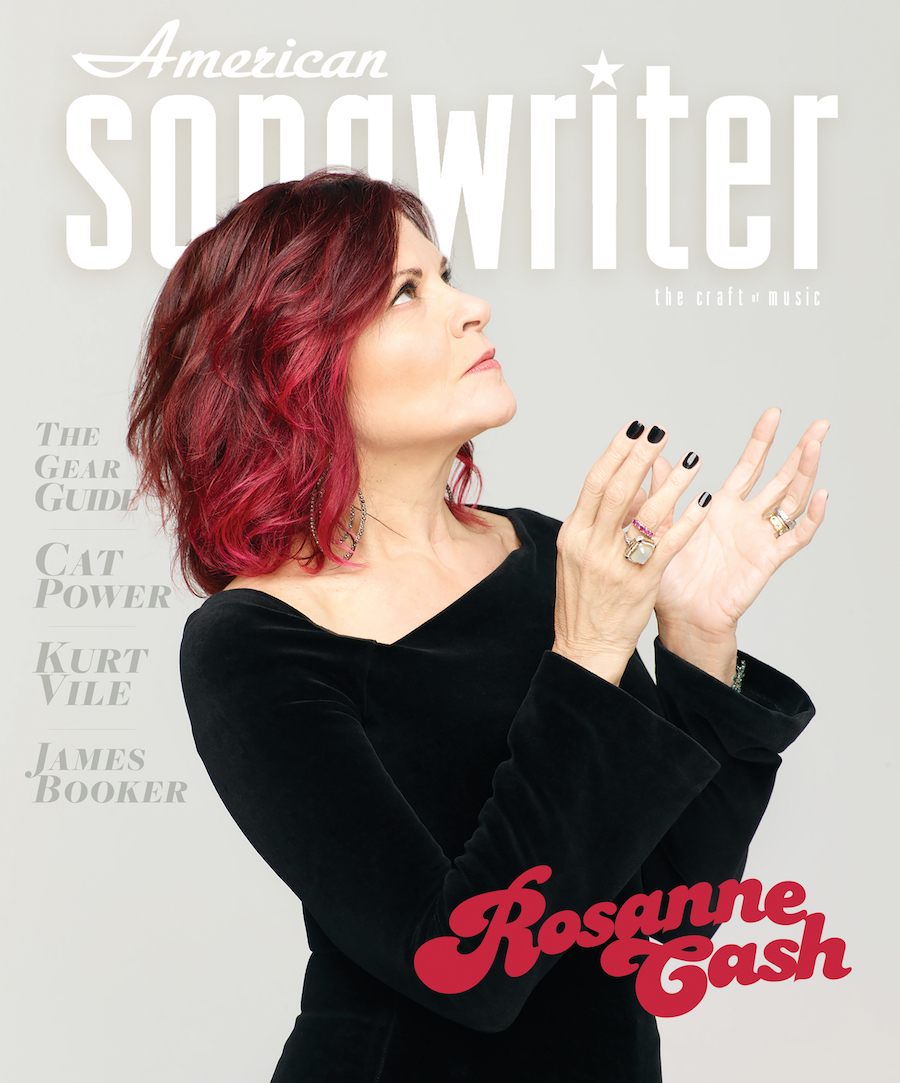
After accepting the “Spirit of Americana” Free Speech Award at the Ryman Auditorium during September’s AmericanaFest, cover subject Rosanne Cash reminded us why we do so. In her words, “Artists and musicians are not damaged outcasts of society, but indispensable members. We are in fact the premier service industry for the heart and soul. We cannot survive without music. It is the language everyone understands in this dangerous and divisive time.” The annual honor was presented by veteran journalist Ken Paulson of the First Amendment Center, an organization that first gave the award to her father, Johnny Cash, in 2002.

Rosanne, an active presence on social media, is an eternally vigilant and outspoken sort. For decades she has advocated against gun violence, even penning an Op-Ed in the New York Times following the gun massacre in Las Vegas last year. The four-time Grammy winner also serves on the board of the Content Creators Coalition (C3), a non-profit that advocates for fair compensation for artists in the digital realm. In the poison pit that is so often Twitter, hers is a voice that is always informed, measured and dashed with humor.

In accepting the Free Speech award, Cash was self-effacing, noting there are others more involved than her on the front lines who live “quiet, heroic lives of active compassion.” The Nashville Songwriters Hall of Fame member is indeed right when she says we can’t survive without music — and besides, who would want to?


****

The music business can be a dreary affair. And when you work in Nashville, the constant machinations of the trade can make it easy to lose sight of why you devoted your life to music in the first place. Because of the economics of the business today, musicians are required to submit to an endless cycle of self-promotion. It’s tiresome for both artist and fan.

Yet despite the rigors of the business, more artists are choosing to step out of the fishbowl and engage directly at the civic level.

“As artists, we know how to self-promote and it’s hugely impactful and freeing to turn that energy outward and lend your voice to a larger effort,” says Nashville-based artist Kate Tucker, who started a community outreach organization called BriteHeart. “Civic engagement is an art form. At BriteHeart, we call it artivism. What do you care about the most? How will you tell the world? Just like we make sure everyone knows about our new record or upcoming tour, there are serious matters at hand and it is art, and music especially, that will bring people together and heal the division in our country. Now is our time.”

Tristen Gaspadarek, another Nashville-based artist who records and tours under her first name and was profiled in these pages last year, has launched a voter-registration program in Music City called Please Vote Nashville. She shows up at concerts and mini-festivals around town, setting up shop, getting people registered, and talking with voters.

“I want to live in a place where everyone feels protected, and cared for,” Gaspadarek says. “This all comes through very literally in my music and poetry. But art is not direct enough for me right now, so I started community organizing.”

“Elections come and go without a peep around town, and it’s a pain to get registered,” she adds. “Please Vote Nashville was created to make all of this easier and to create a culture where voting is cool and most importantly, easy. I wanted to create a space where people can be politically active, without being evangelical.”

For many years Emmylou Harris has been involved with animal rescue with her organization Bonaparte’s Retreat, which you can read more about in this issue. Harris holds a big concert called Woofstock every year to help raise awareness. In large part because of her efforts and pro-adoption message, the euthanasia rate has been reduced drastically in Nashville. Her goal is for all shelters here to ultimately reach no-kill status. “It’s not political at all,” says Emmylou of Woofstock. “Dog lovers are everywhere, regardless of party.”

Political or not, music is never just an end unto itself. It can be a vehicle for a better world, a better life.

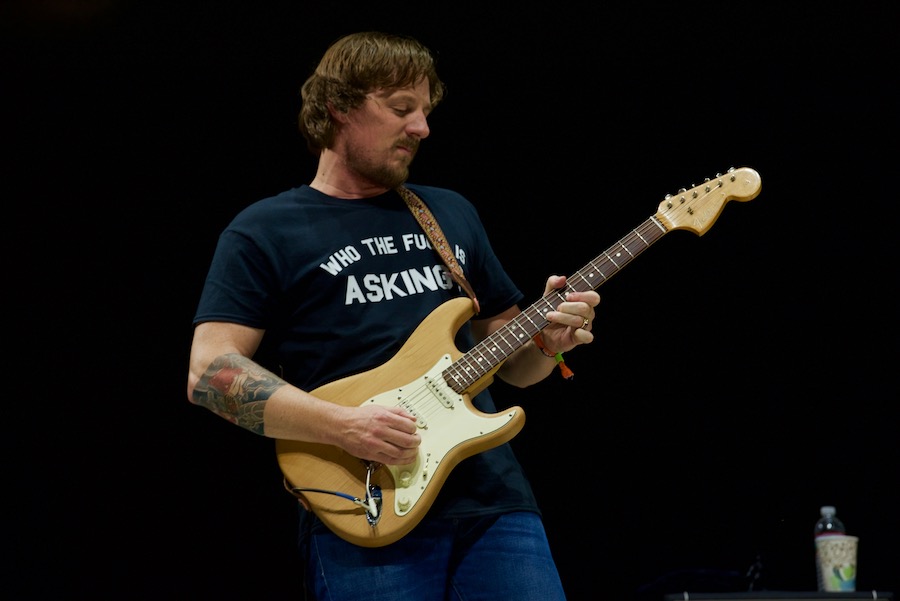
Sturgill Simpson Turns 40, Tears It Up At Bonnaroo

Photo by Mike Stewart

Sturgill Simpson turned 40 years old at Bonnaroo on Friday night. “If this is my mid-life crisis, it’s pretty fucking dope,” he told the crowd shortly into his set on the What Stage as the sun was going down in Manchester, Tennessee.

Wearing a black T-shirt that read “Who The Fuck Is Asking?” — an exercise in meta-merchandising, to be sure (see video below) — Simpson strode onto stage with his four-piece band and kicked into “Welcome To Earth (Pollywog),” the lead track from 2016’s A Sailor’s Guide To Earth.

The tune’s studio version boasts orchestral flourish, but Simpson’s current lineup is decidedly bare bones, and the song’s raw and stripped-down treatment gave the tune, a valentine to his first-born son, an added poignancy. Simpson, for all his shit-kicking tendencies, comes off as a pretty sentimental guy at times. Friday night’s set featured “The Promise,” the ‘80s love ballad originally done by When In Rome, and William Bell’s Stax soul classic, “You Don’t Miss Your Water,” a tune that has cropped up in his sets for the past three years.

Simpson, in many ways, is the perfect candidate to play Bonnaroo, a festival that tries to appeal to so many corners of popular music. His sound traverses so much of the American music vernacular— country, blues, bluegrass, soul, punk, psychedelia, early rock and roll — the notion of genre is rendered irrelevant.

For his Friday night set, there were no visuals or stagecraft to accompany the band, a rarity for an act on the main stage. It was as if he was trying to drive home the point that it was all about the music, as if anyone needed the reminder.

Simpson’s current band is the same retinue he’s been playing with since guitarist Laur Joamets left the group in early 2017, and features Miles Miller on drums, Chuck Bartels on bass, and Bobby Emmett, who famously toppled his organ on SNL, on keys. Many of the tunes were stretched out Friday night, allowing for extended musical interludes that gave Simpson a chance to pick and shred with unbridled ferocity, and for Emmett to cook up a Booker T.-like musical stew on the Hammond B3.

The set featured several selections from A Sailor’s Guide To Earth, along withMetamodern favorite “Turtles All The Way Down,” a tune, Simpson has said, about his past drug use, and not Stephen Hawking.

Of course, drugs are a common theme at Bonnaroo. At one point during the set, Simpson delivered a PSA, telling the crowd, “Ya’ll be safe out there, we don’t want anybody not waking up.”

The message was apropos. On Friday morning, festival attendees woke up to the news that one man had died the night before (of unknown causes), the first death onsite at the festival in three years. There was also the report of the suicide of Anthony Bourdain, the globe-trekking celebrity chef with the rock and roll persona. A serious music lover, Bourdain’s Nashville episode for Parts Unknown in 2016 featured several prominent Music City musicians, Margo Price and Alison Mosshart among them. Bourdain’s death cast a somber cloud over the day’s proceedings, and Paramore’s Hayley Williams addressed it onstage and the creeping darkness of spirit that seems to be gripping so many. “No matter what you’re going through, I know this doesn’t make it go away, but just for one second,” she said, “let’s be present and enjoy music, and dance!”

It was a message taken to heart.

*************

The Instagram video below was taken at Forecastle Fest, in Louisville, on July 15, 2017.

//www.instagram.com/embed.js

We Know Better

image

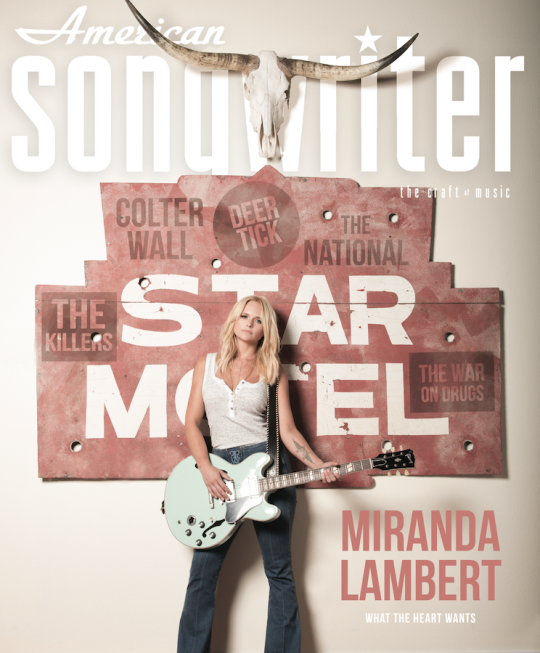
The September/October 2016 issue, featuring Miranda Lambert on the cover, hits newsstands on September 12, but the digital edition will be ready and available for download on September 6. In addition to the feature on Lambert, the issue includes profiles of The National, The War On Drugs, Colter Wall, The Killers, Torres, Ray Wylie Hubbard, and many more. Below is the editor’s note from the new issue.

This issue is going to press just days after a 32-year-old woman named Heather Heyer was run over and killed in broad daylight in Charlottesville, Virginia while protesting a white supremacist rally. Nineteen others were reported injured that day, including a black man named Deandre Harris was severely beaten in a parking garage by some of the marchers.

President Trump drew ire for not immediately denouncing the white supremacists with Unite The Right, a segment that is understood to be part and parcel of his base. The following Monday he finally rebuked them, but for many it was too little, too late. There were also more callings for the firing of White House Chief Strategist Steve Bannon, whose prior work at the right-wing website Breitbart, Bannon once claimed, helped create the platform for the alt-right, a movement dedicated to white supremacy and white nationalism.

As of press time there are plans for more white supremacist rallies and Richard Spenser, the buttoned-up de facto leader of the movement, has vowed to make Charlottesville the center of its universe.

There will no doubt be a flood of songs about Charlottesville. It was a historical moment, to be sure. Wilco released one just two days after the event, with proceeds benefiting the Southern Poverty Law Center. “My dad was named after a Civil War general, and he voted for Barack Obama twice,” Wilco frontman Jeff Tweedy said upon the song’s release. “He used to say, ‘If you know better, you can do better.’ America — we know better. We can do better.”

It’s been argued Trump’s appeal to the white working class is due to the group’s economic desolation. But the alt-right, whose actual numbers don’t appear to be that large, are driven by other things as well. Spencer’s motivation appears to be purely ethnocultural. He is the son of a north Dallas ophthalmologist and holds degrees from the University of Virginia, the University of Chicago, and Duke University. He does not come from a desperate economic situation — he just wants a white nation state.

*******

Art and politics have always been tricky bedfellows, and it is a difficult balancing act when songwriters take on the big societal issues. How constructive is agitprop or rhetoric in songwriting? And how do you avoid just preaching to the choir?

Steve Earle, no stranger to politically tinged songs, says the job of songwriting is about empathy, about making people see the humanity in those different from them (a tall order when dealing with neo-Nazis). Bruce Springsteen has adroitly walked the line between the political and personal. A lifelong Democrat who campaigned for Obama and Hillary Clinton, Springsteen’s audience comprises fans from all political stripes, even though he has caught heat at times. A New York Police group, for instance, called for a boycott after the Boss wrote and performed“American Skin (41 Shots),” a song from ’99 about the shooting of Amadou Diallo by four NYPD plain-clothes officers. Springsteen continues to play the song in concert to this day.

So much of American folk music, it seems, has tilted toward the left. Pete Seeger and Woody Guthrie were not partisans but they frequently targeted fascists and authoritarianism. The famously omitted verse of Guthrie’s “This Land Is Your Land” questions the legitimacy of private property and his song “The Unwelcome Guest,”from the Billy Bragg and Wilco Mermaid Avenue sessions, is a Marxist anthem if there ever was one.

Country music, throughout its history, has spoken to a certain social structure, one that is largely religious and conservative. Haggard’s “Okie From Muskogee” was in many ways a tribute to the white working class. Haggard wrote it, he said, in support of the type of people he grew up with, the ones who were going to be sent to Vietnam because they had no other choice. He was tired of seeing them get picked on by the hippies and privileged class, so he stood up for them.

The late Lou Reed once asked Vaclav Havel, the dissident playwright from Czechoslovakia whose work helped dismantle Communism, and who later became president of the Czech Republic, if art and music could change the world. Havel said art could not change things on its own, but added that it could change people, and it was up to them to take it from there.

Since Trump’s election, there has been a growing chorus calling for country artists to speak out against racism, since they have the ear of rural and conservative America. One mainstream country singer, Kip Moore, took to Instagram after Charlottesville and repudiated the racism he saw growing up that still exists.

“The gift of kindness may start as a small ripple that has the potential of turning into a tidal wave,” Moore wrote. “… It starts with each one of us individually if we wanna change what this world looks like. Go out of your way to take care of people and spread kindness … I’m not tryin’ to preach, but I’m way more concerned with the state of my fellow brother than the state of my Instagram following. Take a break from your 100th bathroom selfie and pay attention to what’s taking place around you.”

Well said, Kip.

— Caine O’Rear, Editor in chief

Written August 14, 2017

Jonny Fritz Reunites With Old Sidekick Joshua Hedley For Joyous Nashville Show

Jonny Fritz lifted more spirits Sunday night than any Nashville preacher could have managed.

For a special one-off show, the artist formerly known as Jonny Corndawg reunited with his old sidekick Joshua Hedley for a night of laughter (and occasional tears) at Nashville’s Basement, a venue Fritz has played innumerable times throughout his career. It was a joyous event, and it felt like getting a dose of the old-time religion, of the sort that involves snake handling and speaking in tongues.

Two years ago Fritz moved to Los Angeles after living in Music City off and on for the past decade. Sunday’s show felt like a homecoming of sorts, with Fritz even remarking at one point that “this feels like home.” And though the part-time leathersmith and occasional American Songwriter contributor espouses a “don’t look back” philosophy, there was a hint of nostalgia in the air for the left-of-center Nashville country scene of the mid to late aughts.

It’s been nearly a decade since we first made the acquaintance of Fritz, back when he was a raw-boned Virginian with a shaved head who bore more than a passing resemblance to a young Billy Bob Thornton. By then he had recorded a few DIY albums, traversed India on a mystic pilgrimage and written a series of “marriage songs” in the midst of a Yerba Matte binge in Argentina. Naturally, we became fast fans. In fact, he may be the only man on Earth we’d send to interview David Allan Coe.

For Sunday night’s show at the Basement, Fritz played mostly stuff from his latest album, the Jim James-produced Sweet Creep. He also dipped into his back catalog for old favorites like “Trash Day,” “Silver Panty Liners” and “Chevy Beretta,” a cult classic he played as early as 2009 at the Basement with Caitlin Rose (who was in the crowd Sunday night) and John McCauley of Deer Tick.

Hedley, who recently signed a solo deal with Third Man Records, did time as Fritz’s fiddle player for years and his playing Sunday night was just as poignant as we remembered it. On stage, the Florida native is like Sancho Panza to Fritz’s Don Quixote, and a better match of performers is not easily imagined.

Wearing tinted glasses and a leisure suit with a front pocket overstuffed with $2 bills, Fritz spun various tales of misadventure throughout the night, including one about going on a Tinder double date with Robert Ellis in downtown Nashville. Another yarn involved his guitar-making father, who, in his previous career as a helicopter nurse, once arrived on the scene to treat a man who’d had his throat slashed in a case of mistaken identity. “Now, that’s a bad day,” Fritz quipped, speaking about the victim.

Before Fritz took the stage, Hedley played a solo set on acoustic guitar. “It’s good to not be playing for tips, for four hours,” he said, referring to the years he spent playing at Robert’s Western World on Lower Broadway. Hedley’s songs are sad as shit, and he warned that anyone in the crowd who was experiencing depression issues might want to leave. The Florida native, who’s also collaborated with Alabama rapper Yelawolf, played a set of originals and covers, including two Mickey Newbury numbers.

One of Hedley’s own tunes, “Don’t Waste Your Tears,” recalled Kris Kristofferson’s “For The Good Times” in its sad beauty. Before playing another original, “Broken Man,” Hedley told a story about a gig in Charlottesville, Virginia, where a woman came up to him after the show and told him that the song had made her cry. When she asked him what it was about, he said, “a one-night stand.” She just got disgusted and walked away, he said.

Editor’s note: Shortly after this article was published, Joshua Hedley tweeted: “Just to clarify; I love playing at @RobertsWWorld for tips and I’m doing it tonight and every Monday at 10pm til I die or get fired.”

Busy Being Born

It was a dark year in the Tower of Song.

Death came calling like a thief in the night, as they say, and took some of our best songwriters with him. David Bowie, Prince, Leonard Cohen, Merle Haggard, Guy Clark. There were many more but one loses count.

We were lucky to have the above as long as we did. All raised holy hell in their time, yet defied the rock-and-roll cliché whose story ends with a good-looking corpse. Each slayed personal demons, survived trends and turbulence in the music business, and continued to write well into their winter years — leaving behind bodies of work that will inspire for some time.

Bowie and Cohen, in particular, said goodbye at the top of their game, serving up two of the best albums of the year.

Even before news of his death broke, Cohen was slated to appear on the cover of this issue. In early October, Senior Editor Paul Zollo, an old acquaintance of the maestro, was invited to attend an international press event in Los Angeles heralding the release of You Want It Darker. The album was debuted in its entirety and a Q&A session followed.

It was a special evening. At one point during the group interview, Cohen singled out Zollo and told the audience, “I just want you to know that Paul Zollo did one of the best interviews with me that I ever did.”

That interview from 1992, which is referenced in the cover story, is full of bon mots and little starbursts of wisdom about the craft. Cohen, an ordained Buddhist monk, was also monastic in his approach to songwriting, often rising at 4:30 a.m. to begin the day’s work. For him, it was always a struggle. “Some people may find it encouraging to see how slow and dismal and painstaking is the process,” he told Zollo, before showing him some of the 60-odd discarded verses he had written for “Democracy.”

There’s a lot more to chew on in this issue, as we sit down with Paul Simon, Randy Newman and Bob Weir, all veteran songwriters who are still busy being born, to borrow Dylan’s phrase, and still raising the bar in the Tower of Song.

– Editor’s Note, American Songwriter – January/February 2017 edition

Steve Earle on the Making of “Terraplane,” And Then Some …

Steve Earle’s old friend has always been the blues, but never has the prolific and mercurial songwriter released a quote unquote blues album. But that will change on February 17 with the arrival of Terraplane Blues, an album that takes its name from the Robert Johnson song about fast cars and even faster women.

Earle, who currently resides in New York City, cut the record this fall in Nashville at House of Blues studios over a 6-day stretch with his band the Dukes. It’s a bit of a breakup album, he says, what with it coming on the heels of his recent split with singer-songwriter Allison Moorer. Terraplane is a raw and dirty affair sonically, and moves from acoustic East Texas blues numbers to boogie-rock to early Stones-type ballads, with one spoken-word piece in iambic pentameter thrown in for good measure. The record was produced by R.S. Field and is being released by New West Records.

We hung out with Earle in the studio  and chatted about the album, and a host of other topics, including the Shakespeare authorship controversy, where Elvis really learned how to “shake it,” and why Earle’s writing songs for ABC’s Nashville.

So how long have you been thinking about making a blues album?
For a while.

I’d thought about doing it at some point as long as seven or eight years ago. I basically had a couple of things going. I wrote some songs that aren’t on this record, and they were sort of headed in one direction, and then the blues songs started to come along. And I don’t know why, but I decided that I’d make a blues record and then I’d make a country record, so that’s what I’m going to do. The country record’s like half-written. And some of the stuff [on the country record] I wrote for Nashville, just because T-Bone [Burnett] asked me to.

The TV show?

Yeah.

Now when I think of Steve Earle making a blues album, I think of the Mance Lipscomb, Lightnin’ Hopkins kind of stuff.

That’s there, but I decided on the Mance thing – there’s a Mance thing and a Lightnin’ thing. You know, Lightnin’ played with a band whenever he could. Mance didn’t, but I don’t think it was a choice. What Mance really did was he played dance music on one guitar when he first started out. So we did a thing that’s very much Mance, but we did it with a band. It’s all acoustic. You know, I’m playing guitar and Chris [Masterson] was playing a baritone resonator. I think that’s what he’s playing. We’ll get drums on it, and upright bass. It’s very much the kind of thing Mance did, the sort of in-between blues and ragtime. I mean, there’s no such thing as between blues and ragtime. There are people that, most of them wearing bowling shirts, will probably listen to this record and say that some of it’s not the blues. But they would be mistaken.
And “Tipitina” is the blues. It’s the 16-bar blues. And pre-war “St. James Infirmary” is the blues. So that stuff’s included. There’s a boogie. I chose Canned Heat rather than ZZ Top for that path. But there’s one song that’s based on the fact that I very much believe, for me, where I come from, the first two ZZ Top records are blues records. And that one track that rocks pretty hard is kind of from that.

So is “Terraplane Blues” your favorite Robert Johnson tune?

No, my favorite Robert Johnson tune is probably “From Four Until Late.” “Terraplane” just seemed like a good title. It’s a car. It’s a fast car. I’ve never wanted to learn how to play “Terraplane,” and I don’t know for sure if I will do it. I’m trying to figure if I can do it. It’s a hard song to sing, so I gotta find some version of it that works for me. [If I do record it], it’ll be an extra track. You have to have an extra track or two.

I know you’re a big patron of Matt Umanov’s guitars in Greenwich Village. 
I’m a big patron of guitar shops in general.

I understand you’re friends with Zeke Schein who works there. He’s a big Robert Johnson guy. 

Zeke knows more about this stuff than anybody that I know. I spent hours talking to him about this record. He knows what tuning all the songs are in. Zeke’s a really good player. He plays all that shit.

Do you think the general perception of blues these days is that it was just a form of folk music and that the dance element and the popular element of what blues used to be in the ‘30s and ‘40s has gotten lost?

Yeah, I mean that’s one thing – this record’s got a song that’s sort of based on “Smoke Stack Lightning.” And “Smoke Stack” – all those Chess records were jukebox records. They were made for people to dance to. They weren’t long and there wasn’t a lot of improvisation on them. They were improvising, but there wasn’t a shitload of long solos because they wrote two minute and 30 second records. And that’s represented here. But it very much sounds like this band. It’s the best band I’ve ever had. The existence of the band was part of the inspiration for making the record. Finally doing it had as much to do with Chris being in the band as anything else because I never had the guitar player to do it.

Did your time in New Orleans working on HBO’s Treme inform this album? 

Absolutely.

It wasn’t until recently that I learned that “My Bucket’s Got A Hole In It” was actually taught to Hank Williams by that blues musician who’s from New Orleans.

“Tee Tot” [Rufus Payne] is the story … I don’t know how much there is [to all that] … there’s all those stories about how black music and white music … I don’t know. The legend says that Elvis got all those moves from watching black gospel groups and watching bands on Beale Street. I know where he got everything he got. It was from Wally Fowler. Wally Fowler was the founder of the Oak Ridge Boys. He was the first white gospel singer to perform the way that black gospel groups did. You know, to not just stand there. He was the first real showman in white gospel music and he founded the Oak Ridge Boys. And there’s been an Oak Ridge Boys ever since.

When Guitar Town was written I was writing for Sunberry/Dunbar, which belonged to the Oak Ridge Boys and was run by my publisher, Noel Fox, who was the last bass singer in a non-secular version of the Oak Ridge Boys. Oak Ridge Boys are a gospel group. And [Richard] Sterban took over. Sterban came from J.D. Sumner, who replaced Noel because Noel quit. Noel went out and worked for Olan Mills or something, you know, selling people pictures of themselves for years. When the Oaks got big they brought Noel back to run their publishing company. He was a great song man. He’s gone now, but there would be no Guitar Town without Noel. He told me to write an album and not worry whether or not it would get you a record deal, and I had just lost my first record deal after being here for 12 or 13 years. I was pretty discouraged, and didn’t have much faith in myself as a writer anymore. And I wrote the songs that became Guitar Town in about 11 months.

But I heard all the war stories from him and from the Oaks and from those guys during that period, and they set me straight on where Elvis got that shit, and I believe it’s true. It just makes more sense. I went back and found a couple of films of Wally Fowler performing and [I was like] “ohhh …”

But it took a while to get poor white people and poor black people at each other’s throats, and it didn’t always take. There was already someone who was interested, like upper middle class kids like Sam Phillips slummin’ just because they loved the music. He ended up starting Sun Records, that kind of stuff. So you know, it couldn’t stay contained forever, the two things. And Sam knew, and that’s not a legend. He looked for years and [said], “If I can find a white kid, a good looking white kid who can sing this stuff, then I’m going to get rich.” He didn’t get as rich as he should have, but he got rich.

You’ve got a history of borrowing from the blues lexicon in your own tunes. And you taught that course at the Old Town School of Folk Music years ago, I think it was titled “The Cool Shit To Steal.” How do you walk that line between borrowing from traditional material and coming up with original stuff? You know, so much of the folk tradition is obviously about borrowing. 

It is, but in the blues it’s really tricky because it’s a limited genre. Some of this stuff is definitely post-Bob Dylan blues. Dylan started making blues records on purpose a long time ago. It begins on Bringing It All Back Home and it’s fully realized on Highway 61. Everything is in a blues form from that point on for a while, until probably Nashville Skyline or John Wesley Harding maybe. And I thought that it would be sort of fun to do something where I didn’t necessarily have to come up with a lot of melodies, that I would find at least the components for the melodies in this toolbox that’s called the blues.

Some of it’s more original that I thought it would be, melodically. The lyrics I pushed as hard as I’ve ever pushed. Some of the best lyrics I’ve ever written are on this record. I wrote a spoken word piece in iambic pentameter again. That’s me making up for my lack of education. I didn’t get a chance to write in iambic pentameter in high school because I only got halfway through the 9th grade.

So are you still a big Shakespeare buff?

Yeah. I don’t think that the glovemaker’s son wrote those plays, but yeah. I think Edward de Vere, the 17th Earl of Oxford, wrote them. So does the greatest Shakespearean actor of our time, so did Mark Twain, so does Meryl Streep.

I don’t know if I believe that. Is there evidence?

There’s tons of evidence. There’s evidence both ways. You should read all the books and make up your own mind about it. There’s no way it was a bunch of people. It was one person, in my mind, and it pisses Billy Bragg off because he thinks I’m being elitist, and I’m far from an elitist.

There’s no way [it was] someone who’d never been to Italy, was illiterate, or in other words couldn’t form words, and that’s probably true of Shakespeare and most actors of his time. He could read but he couldn’t write, because that was a much harder thing to learn to do then. He had no intimate knowledge of life at court, and didn’t have political protection to keep him from getting his fucking head chopped off with some of the things he was parodying and some of the things he was writing about when he was writing them.

So the theory about de Vere is that he was either Elizabeth’s son or Elizabeth’s lover. Some people even think both. My guess is that he was her son, or somehow related to her, anyway. And so he got away with it. But it’s one person, it’s a singular genius voice. There’s no way it was more than one person, no way there was more than one person that brilliant in Elizabethan England, when there were only a 100,000 people in London and the whole area. It just doesn’t make sense.

Like with Marlowe and Ben Jonson. Their voices were so different from the Shakespeare plays, there’s just no way …

Yeah, and Ben Jonson is where a lot of the clues that it may have been de Vere come from. Ben Jonson wrote the preface to the First Folio, he’s the one who called him “The Soul Of The Age” and all that stuff. And they all were writing really great stuff, but nobody was writing anything like that. And nobody really emulated him in his time. Shortly after he died people did. And he became a big deal – Shakespeare’s plays were being staged and they were hits in London. And at that moment Elizabeth was patronizing theater. She didn’t go out to the theater, she couldn’t do that, but plays were brought in and performed at court. And she was the very first monarch in Europe that did that, which is another clue.

But there are a lot of books about it, and there’s a lot of evidence, and people are horrified of it. There’s a film called Anonymous that’s about the authorship and it’s just a shoot-em-up. Every theory is about Edward de Vere being the actual William Shakespeare, and who the real William Shakespeare was, and why he got set up. I think it’s really simple. I think he had to have a front because he was the Earl of Oxford and he couldn’t be a playwright, so I think he just set up a guy and paid him, because Shakespeare retired and went back to his hometown and set himself up in a wool business and fucking sold wool for the rest of his life after becoming the greatest playwright and actor of his age. It just doesn’t make sense.

He was a hoarder too; he hoarded grain during the plague, which was a bad thing to do.

Yeah, he was a businessman. That’s what he was. He was a Republican. But yeah, I believe that.

(American Songwriter, April 2015)

Kristofferson

“It was only the real songwriters and pickers that went in there,” Kris Kristofferson says of The Professional Club, his favorite watering hole on Music Row back in the ‘60s. “It was never any civilians. Two [new] guys came in once and I guess they wanted to crack the music business or something. They were so uncomfortable they left after 15 minutes … Those were great days, though. Everybody was living for the song. You didn’t care about fame or fortune or whatever. The old guys who were playing on the Opry they would come in, too. I was in heaven.”

Kris Kristofferson is back in Nashville, chatting with me at his manager’s office on Music Row. He’s here to perform at a tribute concert for his friend Cowboy Jack Clement, and to promote his new album, Feeling Mortal. It’s a stirring collection of songs produced by his long-time compadre Don Was, the man he credits with rescuing his career – and life – from a pit of despair in the early ‘80s, when he was still reeling from his divorce from Rita Coolidge, as well as the fusillage of negative criticism that had been hurled toward Michael Cimino’s film Heaven’s Gate (in which he starred), widely considered one of the biggest cinematic flops in history.

As an actor, Rhodes scholar, athlete, etc., Kristofferson boasts Renaissance man credentials, but it’s as a songwriter that he really shines. His body of work, which includes “Me And Bobby McGee,” “Sunday Morning Coming Down,” and “Help Me Make It Through The Night,” occupies an august and substantial niche in the American songbook. But despite his hall-of-fame success, Kristofferson is not one to rest on his laurels, and, at age 76, he’s turned in an impressive new album, full of songs as vital as those he was writing as a young man in his 30s.

Sitting here in an office building on Music Row, he appears to get a twinkle in his eye when our talk drifts to the subject of the old days. He says the scenes in “Sunday Morning Coming Down,” are set on the same street we’re now on. “I wrote that about Music Row because they closed the bars on Sunday,” he says. “I think it hit a lot of people who drank as much as I did … You couldn’t buy liquor by the drink back then … you were supposed to bring your own bottle and drink it.”

When he performs the “Sunday Morning Coming Down” for us, which you can hear on Americansongwriter.com, he accidentally sings the original version, which contains a line that he says he was forced to take out. “I’d smoked so much the night before my mouth was like an ashtray that I’d been licking.”

Music Row was certainly a wilder place in the ‘60s, to hear Kristofferson tell it, and few vestiges of that less-commodified world remain today, with the possible exception of Bobby’s Idle Hour, a smoke-filled den just down the streets that serves cheap beer and hosts weekly songwriter nights for “knowns and unknowns.”

Kristofferson himself was an unknown when he first showed up in Music City, and, after kicking around for a few years, working stints as a janitor, bartender and commercial helicopter pilot, the former Army brat began to make a name for himself, and started palling around with simpatico songwriters like Mickey Newbury, Shel Silverstein and, of course, Willie Nelson. As far as Nashville songwriters, he says Willie was the one they all looked up to.

“We thought he’d never be famous because he was too deep for the average music audience and he had his own style and his own way of singing. I never met him the first four years I was here. But we all kind of idolized him. And he hasn’t changed a bit; he is the exact same guy that he was then.”

Kristofferson doesn’t appear to be exact same guy from yesteryear. Feeling Mortal reveals a more contented man than the one whose voice we heard in all those early classics. But in a sense he is the same kind of artist, making music that he believes in, still living for the song.

That Old Time Feeling

Guy Clark rolls another cigarette, fires it up, and then proceeds to spread his poison across the room. We’re sitting in his workshop at his Nashville home, where he’s agreed to play a few songs for us on camera.

For the last decade or so, the workshop has served as his sanctuary, so to speak, the place where he writes songs, builds guitars (which he marks with his own blood thumbprint), and gets down to the business of being Guy Clark.

It’s a surprisingly small space, given all that he does in it, but it’s not unlike the way he dreamed it, he says. A library of cassettes blankets one wall, with numerous offerings by Rodney Crowell, Tom Waits, and Mance Lipscomb, among others. At the other end sits his guitar work-station, where his tools are arranged neatly on the wall and in coffee cans. There’s also a poster that details the specs of a flamenco guitar. The first guitar Clark ever built, back in the mid-60s, was modeled after a flamenco model designed by esteemed Spanish luthier Domingo Esteso, and he’s made several like it since.

During our visit, the West Texas native plays three new songs, because “ya’ll need to hear them and I need the practice,” he says. He talks and smokes between tunes, tamping his cigarette into an ashtray decorated with skulls, a gift given to him by his friend Emmylou Harris.

One of the songs, “My Favorite Picture Of You,” is based on an old Polaroid of his wife Susanna. He pulls the picture out to show us. “Me and Townes were in that house drunk on our ass, being totally obnoxious,” he says, pointing to the pic. “And Susanna had finally had enough, and said ‘I’m leaving.’ I think John Lomax was outside and he took that picture. And for some reason, that has always been my favorite picture of her.”

The fact that Townes was complicit in this episode is not surprising. A long-time compadre of Clark’s and a fellow outlaw spirit, Van Zandt is a constant theme this afternoon, constantly cropping up in conversation. A black-and-white photo of the late Texas songwriter, taken in the early ‘90s, hangs high on the wall and looks out on the whole scene. “Townes always said he wanted to die here in this house,” Clark says. (Rodney Crowell is also referenced constantly. An oil painting of Crowell that Clark did hangs next to his own self-portrait in another room.)

Sitting here, listening to the songs and stories amid the heavy smoke and old photographs, you can’t help but feel the magic –especially if you’re steeped in the mythos of the Texas songwriting canon. We’re still smack in the suburbs of Nashville, to be sure, but it sure doesn’t feel like it. The plasticity of Music Row feels worlds away.

Clark turns 70 this month, a milestone that has birthed a double-disc tribute album, with guest turns from Crowell, John Prine, Hayes Carll, and many others. Willie Nelson serves up a great rendition of “Desperados Waiting For A Train,” a tune Clark wrote in his 30s about an old-timer of 70 years with a tobacco-stained chin. Talk about full circle.

It’s already been a pretty good year for the songwriter. On this day in late summer his new live album, Songs And Stories, recorded at the Belcourt Theatre in Nashville, is the number one seller in Amazon’s mp3 store. But he doesn’t seem to be too impressed by it. “My record label called to tell me that … I said, ‘Great, send me the check.’”

In his later years, Clark says he’s turned to co-writing more, due to the fact that “he got stuck and ran out of shit to say.” He says the last song he wrote completely by himself was “Dublin Blues,” back in the mid-90s. Instead, he now collaborates with whatever young gun he can.

Even at 70, Clark refuses to quit. He’s still lighting out after inspiration.

Buy the issue.