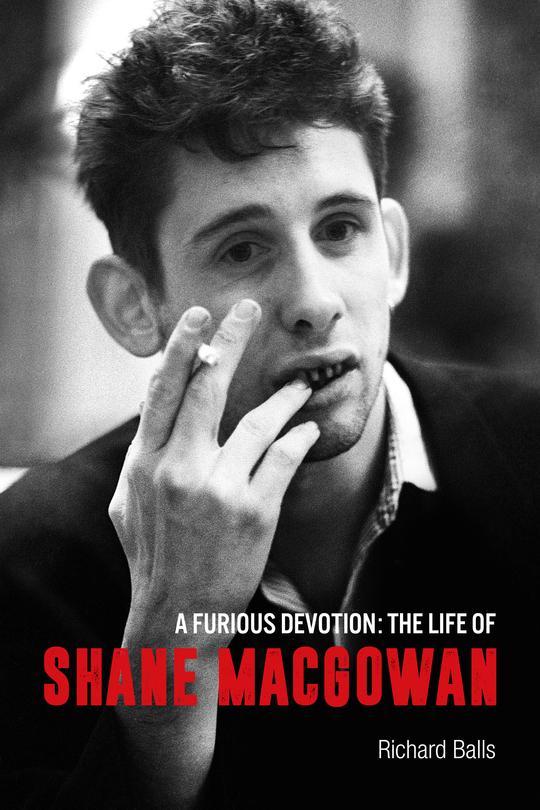
Review of Shane MacGowan Biography, “A Furious Devotion” (Rolling Stone)

Writing the biography of the man best known for marrying traditional Irish music with British punk — a sound once described by concertina player Noel Hill of the band Planxty as a “terrible abortion” of Irish music — was never going to be easy. To further complicate the matter, Shane MacGowan’s hatred of interviews is almost as notorious as his long and sophisticated affair with drugs and alcohol. Such is punk.

When it comes to the story of MacGowan’s life, it has never been about “just the facts.” However, an attempt has now been made. A Furious Devotion: The Life of Shane MacGowan by British journalist Richard Balls serves up the most thorough account of the man — and myth — to date. In a nearly 400-page biography, out Nov. 18 in the U.S., Balls has attempted through extensive interviews and research to do what has proved so difficult through the years — to parse where the facts end and the myth begins. “Some of these never get resolved and probably never will be, but I am determined not to give up in my quest to sort the myths from the truths and better understand this shy and complex man,” Balls writes.

The son of Irish émigré parents, MacGowan was born and raised in England and spent childhood summers and holidays in rural County Tipperary, Ireland, with his mother’s extended family of staunch Irish republicans. Now residing in Dublin, he still speaks with an English accent, but maintains that he is Irish, for it was those experiences in Ireland that MacGowan says formed his musical and spiritual core. Some of the first traditionalists to hear the Pogues amalgamations might have been shocked, even appalled, but other icons of traditional Irish music such as the Dubliners and Christy Moore understood the power of MacGowan’s writing early on.

Read more at Rolling Stone.

Cold War

We were spies in a foreign land
I was a fugitive, running just as fast as I can
You were a bird on a bludgeoned wing, busted flat in Dallas
Dancing for a diamond ring

You asked me if I’d been here before
As I regaled you with memories of my melancholy whores
You crossed your legs and lit a cigarette
Talked about your mama, and said as your eyes got wet

I’m tired of fighting in this cold war
Nobody wins that’s just daddy’s drunken folklore
I’m leaving this town tomorrow you can come if you want

In the armpit of Arkansas
Where the river split and sang neath the stillborn stars
You started bitching we were out of beer
As we danced real close and came upon a midnight clear

In the morning with the mountain dew
And the sun’s cruel eye, the day after Waterloo
Lou Reed and that summer in Siam, you took a walk on the wild side
Oliver Stone in Vietnam

I’m tired of fighting in this cold war
Don’t want to die for a country I don’t know no more

Baez

From American Songwriter interview, 2013.

Joan Baez epitomizes the ideal of the American folk singer. Ever since rising to national prominence in the early ‘60s, she’s stood at the crossroads of music and social protest, adhering firmly to the belief that music can in fact change the world.

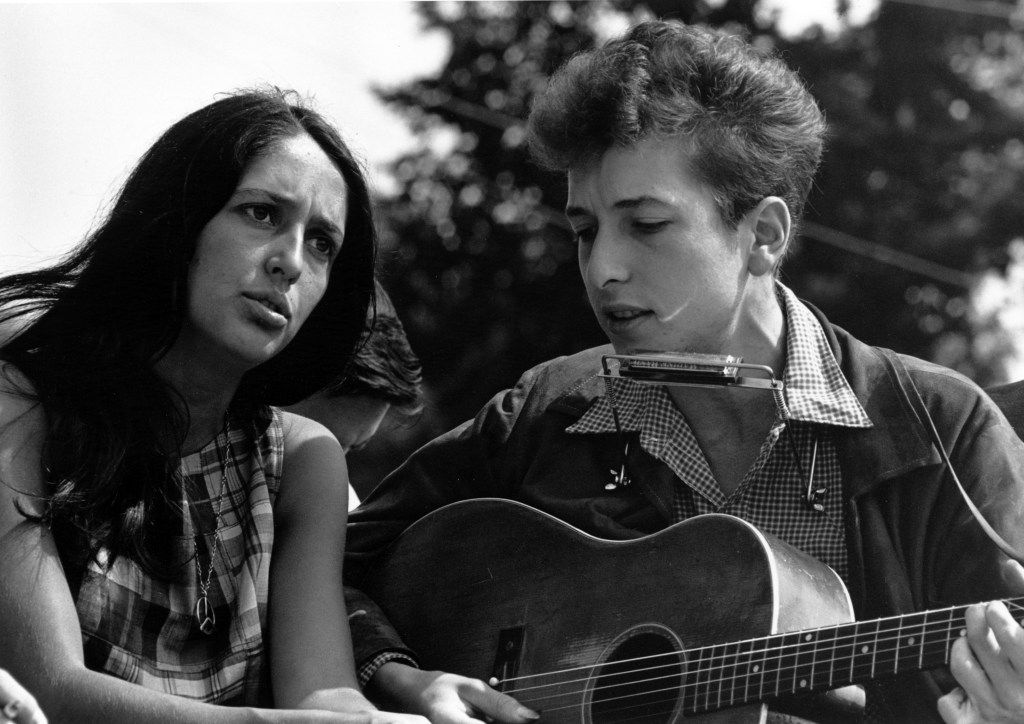
Baez cut her teeth as a singer in the Cambridge, Massachusetts folk scene of the late ‘50s, when she was enrolled in college at the Boston University School Of Drama. She was signed to Vanguard Records in 1960, and soon became an international sensation. Early in her career, she met Bob Dylan, who at the time was hailed as the second coming of Woody Guthrie. Baez helped introduce the young Dylan to the world at large, sharing the stage with him and recording his songs.

Throughout her career, Baez has primarily been known as an interpreter of other people’s work. However, many of her own compositions, such as “Diamonds And Rust” and “Here’s To You,” reveal her depth as a lyricist and songwriter.

Baez continues to record and tour – and she looks and sounds great. Her last album, Day After Tomorrow, was produced by Steve Earle, and features songs by Elvis Costello, Gillian Welch, Tom Waits and others.

Do you remember the process of writing that song? Was that one that came in a burst or did you cultivate it for a while?

As this story is being written, Baez is set to embark upon a tour of France, followed by another tour with Kris Kristofferson, whom she first met at the Isle of Wight festival years ago. We spoke with the singer about Dylan, songwriting, and the state of American politics.

You’re known primarily for the songs you cover. Was there ever a point when you considered writing more of your material?

I haven’t written for the last 20 years. I think the poetry in my songs is really good. And I think the melodies are really good. And I think the only trick with my songs is that they’re not the kind of songs that people are urged to cover because they’re more personal. I write them more personal; it’s like reading a poetry book.

“Diamonds And Rust,” which is one of your more well-known compositions, fits more into that personal category.

Yeah, and it’s the only one that crossed over from very personal to being acknowledged in a very big way.

Well, it’s funny because I was writing it and it had nothing to do with what it turned out to be [Ed note: It’s widely believed to be about Bob Dylan]. I don’t remember what it is, but I think I was writing a song. It was literally interrupted by a phone call, and it just took another curve and it came out to be what it was.

Your history with Bob Dylan is a significant part of your legacy as an artist, which I imagine has been a double-edged sword for you. Was there ever a point where you considered not covering Dylan songs in concert?

His songs are so amazing. Even through his dormant period, for me, his songs can stand on their own. They’re the best.

When you play the Dylan songs live, does your relationship to them feel more aesthetic than personal?

Well, yeah. I haven’t seen him at a lot of them [my concerts], but he was very sweet in my documentary. So, I think the playing field’s level, and the songs are what they are.